The sum of a two-digit number and the number formed by reversing the order of digit is 66. If the two digits differ by 2, find the number. How many such numbers are there?
Advertisements
प्रश्न
The sum of a two-digit number and the number formed by reversing the order of digit is 66. If the two digits differ by 2, find the number. How many such numbers are there?
Advertisements
उत्तर
Let the digits at units and tens place of the given number be x and y respectively. Thus, the number is ` 10 y + x`
The two digits of the number are differing by 2. Thus, we have ` x - y =+- 2`
After interchanging the digits, the number becomes `10 x + y.`
The sum of the numbers obtained by interchanging the digits and the original number is 66. Thus, we have
`(10 x + y ) + ( 10 y + x )= 66`
` ⇒ 10 x + y + 10 y + x = 66`
`⇒ 11 x + 11y = 66 `
` ⇒ 11 ( x + y) = 66/11`
` ⇒ x + y = 66/11`
` ⇒ x + y =6`
So, we have two systems of simultaneous equations
`x - y = 2`
` x + y = 6`
` x - y = -2`
` x + y = 6`
Here x and y are unknowns. We have to solve the above systems of equations for x and y.
(i) First, we solve the system
` x - y = 2`
` x + y = 6`
Adding the two equations, we have
`( x - y ) + ( x + y )= 2 + 6`
`⇒ x - y + x + y = 8`
` ⇒ 2x = 8`
` ⇒ x = 8/2`
` ⇒ x = 4`
Substituting the value of x in the first equation, we have
` 4 - y = 2`
`⇒ y = 4 -2`
`⇒ y = 2`
Hence, the number is ` 10 xx 2 + 4 = 24`.
(ii) Now, we solve the system
` x - y= -2`
` x + y = 6`
Adding the two equations, we have
` ( x - y) + ( x + y) = -2 + 6`
`⇒ x - y + x + y = 4 `
` ⇒ 2x = 4`
` ⇒ x = 4/2`
` ⇒ x = 2`
Substituting the value of x in the first equation, we have
` 2 - y = -2`
` ⇒ y = 2 + 2`
` ⇒ y = 4`
Hence, the number is ` 10 xx 4 + 2 = 42`
There are two such numbers.
संबंधित प्रश्न
Solve the following system of equations: 15x + 4y = 61; 4x + 15y = 72
Solve for x and y : `\frac { ax }{ b } – \frac { by }{ a } = a + b ; ax – by = 2ab`
Solve the following system of linear equations :
2(ax – by) + (a + 4b) = 0
2(bx + ay) + (b – 4a) = 0
Solve the following pair of linear equation by the elimination method and the substitution method.
`x/2 + (2y)/3 = -1 and x - y /3 = 3`
Form the pair of linear equation in the following problem, and find its solution (if they exist) by the elimination method:
The sum of the digits of a two-digit number is 9. Also, nine times this number is twice the number obtained by reversing the order of the digits. Find the number.
In an envelope there are some 5 rupee notes and some 10 rupee notes. Total amount of these notes together is 350 rupees. Number of 5 rupee notes are less by 10 than twice number of 10 rupee notes. Then find the number of 5 rupee and 10 rupee notes.
Sanjay gets fixed monthly income. Every year there is a certain increment in his salary. After 4 years, his monthly salary was Rs. 4500 and after 10 years his monthly salary became 5400 rupees, then find his original salary and yearly increment.
Solve the following simultaneous equation.
x + y = 11 ; 2x - 3y = 7
Solve the following simultaneous equation.
`2/x + 3/y = 13` ; `5/x - 4/y = -2`
A fraction becomes `1/3` when 2 is subtracted from the numerator and it becomes `1/2` when 1 is subtracted from the denominator. Find the fraction.
If 52x + 65y = 183 and 65x + 52y = 168, then find x + y = ?
Complete the activity.
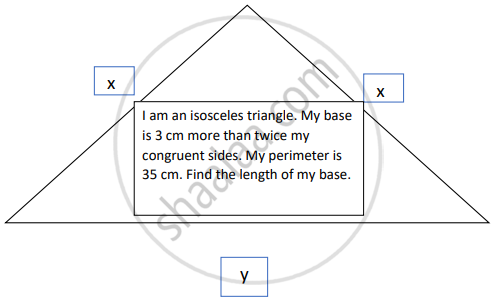
The sum of the two-digit number and the number obtained by interchanging the digits is 132. The digit in the ten’s place is 2 more than the digit in the unit’s place. Complete the activity to find the original number.
Activity: Let the digit in the unit’s place be y and the digit in the ten’s place be x.
∴ The number = 10x + y
∴ The number obtained by interchanging the digits = `square`
∴ The sum of the number and the number obtained by interchanging the digits = 132
∴ 10x + y + 10y + x = `square`
∴ x + y = `square` ...(i)
By second condition,
Digit in the ten’s place = digit in the unit’s place + 2
∴ x – y = 2 ...(ii)
Solving equations (i) and (ii)
∴ x = `square`, y = `square`
Ans: The original number = `square`
The sum of the digits of a two-digit number is 9. If 27 is added to it, the digits of the number get reversed. The number is ______.
The angles of a triangle are x, y and 40°. The difference between the two angles x and y is 30°. Find x and y.
The age of the father is twice the sum of the ages of his two children. After 20 years, his age will be equal to the sum of the ages of his children. Find the age of the father.
The angles of a cyclic quadrilateral ABCD are ∠A = (6x + 10)°, ∠B = (5x)°, ∠C = (x + y)°, ∠D = (3y – 10)°. Find x and y, and hence the values of the four angles.
Read the following passage:
Two schools 'P' and 'Q' decided to award prizes to their students for two games of Hockey ₹ x per student and Cricket ₹ y per student. School 'P' decided to award a total of ₹ 9,500 for the two games to 5 and 4 Students respectively; while school 'Q' decided to award ₹ 7,370 for the two games to 4 and 3 students respectively. |
Based on the above information, answer the following questions:
- Represent the following information algebraically (in terms of x and y).
- (a) What is the prize amount for hockey?
OR
(b) Prize amount on which game is more and by how much? - What will be the total prize amount if there are 2 students each from two games?
