Advertisements
Online Mock Tests
Chapters
2: Polynomials
▶ 3: Pair of Linear Equations in Two Variables
4: Quadratic Equations
5: Arithmetic Progressions
6: Co-ordinate Geometry
7: Triangles
8: Circles
9: Constructions
10: Trigonometric Ratios
11: Trigonometric Identities
12: Heights and Distances
13: Areas Related to Circles
14: Surface Areas and Volumes
15: Statistics
16: Probability
![R.D. Sharma solutions for मैथमैटिक्स [अंग्रेजी] कक्षा १० chapter 3 - Pair of Linear Equations in Two Variables - Shaalaa.com](/images/mathematics-english-class-10_6:df8cedf76b7f4149972b35ec991c0c9d.jpg "R.D. Sharma solutions for मैथमैटिक्स [अंग्रेजी] कक्षा १० chapter 3 - Pair of Linear Equations in Two Variables")
Advertisements
Solutions for Chapter 3: Pair of Linear Equations in Two Variables
Below listed, you can find solutions for Chapter 3 of CBSE, Karnataka Board R.D. Sharma for मैथमैटिक्स [अंग्रेजी] कक्षा १०.
R.D. Sharma solutions for मैथमैटिक्स [अंग्रेजी] कक्षा १० 3 Pair of Linear Equations in Two Variables EXERCISE 3.1 [Page 3.8]
BASIC
Akhila went to a fair in her village. She wanted to enjoy rides on the Giant Wheel and play Hoopla (a game in which you throw a rig on the items kept in the stall, and if the ring covers any object completely you get it.) The number of times she played Hoopla is half the number of rides she had on the Giant Wheel. Each ride costs Rs 3, and a game of Hoopla costs Rs 4. If she spent Rs 20 in the fair, represent this situation algebraically and graphically.
Aftab tells his daughter, “Seven years ago, I was seven times as old as you were then. Also, three years from now, I shall be three times as old as you will be.” (Isn’t this interesting?) Represent this situation algebraically and graphically.
The path of a train A is given by the equation 3x + 4y − 12 = 0 and the path of another train B is given by the equation 6x + 8y − 48 = 0. Represent this situation graphically.
Gloria is walking along the path joining (–2, 3) and (2, –2), while Suresh is walking along the path joining (0, 5) and (4, 0). Represent this situation graphically.
On comparing the ratios `bb(a_1/a_2, b_1/b_2)` and `bb(c_1/c_2)` without drawing them, find out whether the lines representing the following pair of linear equations intersect at a point, are parallel or coincide.
5x – 4y + 8 = 0
7x + 6y – 9 = 0
On comparing the ratios `bb(a_1/a_2, b_1/b_2` and `bb(c_1/c_2)` without drawing them, find out whether the lines representing the following pair of linear equations intersect at a point, are parallel or coincide.
9x + 3y + 12 = 0
18x + 6y + 24 = 0
On comparing the ratios `bb(a_1/a_2, b_1/b_2)` and `bb(c_1/c_2)` without drawing them, find out whether the lines representing the following pair of linear equations intersect at a point, are parallel or coincide.
6x – 3y + 10 = 0
2x – y + 9 = 0
Given the linear equation 2x + 3y – 8 = 0, write another linear equation in two variables such that the geometrical representation of the pair so formed is:
- Intersecting lines
- Parallel lines
- Coincident lines
The cost of 2 kg of apples and 1 kg of grapes on a day was found to be Rs 160. After a month, the cost of 4 kg of apples and 2 kg of grapes is Rs 300. Represent the situation algebraically and geometrically.
R.D. Sharma solutions for मैथमैटिक्स [अंग्रेजी] कक्षा १० 3 Pair of Linear Equations in Two Variables EXERCISE 3.2 [Pages 3.17 - 3.19]
BASIC
Solve the following system of equations graphically:
3x + y + 4 = 0
3x – y + 2 = 0
Solve the following system of equations graphically:
x = 0
y = –7
Show graphically that the following system of equations has infinitely many solutions:
2x + 3y = 6
4x + 6y = 12
Show graphically that the following system of equations has infinitely many solutions:
x – 2y + 11 = 0
3x – 6y + 33 = 0
Show graphically that the following system of equations is in-consistent (i.e. has no solution):
3x – 5y = 20
6x – 10y = – 40
Show graphically that the following system of equations is in-consistent (i.e. has no solution) :
3x – 4y – 1 = 0
`2x - 8/3 y + 5 = 0`
Determine graphically the vertices of the triangle, the equations of whose sides are given below:
2y – x = 8, 5y – x = 14 and y – 2x = 1
Determine graphically the vertices of the triangle, the equations of whose sides are given below:
y = x, y = 0 and 3x + 3y = 10
Determine, graphically whether the system of equations x – 2y = 2, 4x – 2y = 5 is consistent or in-consistent.
Determine, graphically whether the following system of linear equations is consistent or in-consistent:
x = 0, y = –7
Determine, by drawing graphs, whether the following system of linear equations has a unique solution or not:
2x – 3y = 6, x + y = 1
Determine, by drawing graphs, whether the following system of linear equations has a unique solution or not:
2y = 4x – 6, 2x = y + 3
Solve graphically the following system of linear equations. Also, find the coordinates of the points where the lines meet axis of y:
2x – 5y + 4 = 0
2x + y – 8 = 0
Solve graphically the following system of linear equations. Also, find the coordinates of the points where the lines meet axis of y:
3x + 2y = 12
5x – 2y = 4
Solve graphically the following system of linear equations. Also, find the coordinates of the points where the lines meet axis of y:
x + 2y = 6
3x – 2y = 2
Solve the following system of linear equations graphically and shade the region between the two lines and x-axis:
2x + 3y = 12
x – y = 1
Solve the following system of linear equations graphically and shade the region between the two lines and x-axis:
3x + 2y – 4 = 0
2x – 3y – 7 = 0
Draw the graphs of the following equations on the same graph paper:
2x + 3y = 12
x – y = 1.
Find the coordinates of the vertices of the triangle formed by the two straight lines and the y-axis.
Draw the graphs of the equations x – y + 1 = 0 and 3x + 2y – 12 = 0. Determine the coordinates of the vertices of the triangle formed by these lines and the x-axis, and shade the triangular region.
Draw the graphs of the equations 5x – y = 5 and 3x – y = 3. Determine the co-ordinates of the vertices of the triangle formed by these lines and the y-axis.
10 students of class X took part in a Mathematics quiz. If the number of girls is 4 more than the number of boys, find the number of boys and girls who took part in the quiz.
Form the pair of linear equations in the following problems, and find their solutions graphically.
5 pencils and 7 pens together cost Rs 50, whereas 7 pencils and 5 pens together cost Rs 46. Find the cost of one pencil and that of one pen.
BASED ON LOTS
Draw the graphs of the following equations:
2x – 3y + 6 = 0
2x + 3y – 18 = 0
y – 2 = 0
Find the vertices of the triangle so obtained. Also, find the area of the triangle.
Form the pair of linear equations in the following problems, and find their solution graphically:
Champa went to a 'sale' to purchase some pants and skirts. When her friends asked her how many of each she had bought, she answered, "The number of skirts is two less than twice the number of pants purchased. Also, the number of skirts is four less than four times the number of pants purchased." Help her friends to find how many pants and skirts Champa bought.
Given the linear equation 2x + 3y – 8 = 0, write another linear equation in two variables such that the geometrical representation of the pair so formed is:
- Intersecting lines
- Parallel lines
- Coincident lines
Graphically, solve the following pair of equations:
2x + y = 6, 2x – y + 2 = 0
Find the ratio of the areas of the two triangles formed by the lines representing these equations with the x-axis and the lines with the y-axis.
Determine, graphically, the vertices of the triangle formed by the lines y = x, 3y = x, x + y = 8.
Draw the graph of the equations x = 3, x = 5 and 2x – y – 4 = 0. Also, find the area of the quadrilateral formed by the lines and the x-axis.
Draw the graphs of the lines x = –2 and y = 3. Write the vertices of the figure formed by these lines, the x-axis and the y-axis. Also, find the area of the figure.
Solve the following system of equations graphically:
2x – y – 2 = 0
– 4x + y + 4 = 0
Also, find the absolute difference between the ordinates of the points where given lines cut y-axis.
Solve the following system of equations graphically:
2x + y = 5 and 4x – y = 7. Hence, write the coordinates of the points where given lines meet y-axis.
Solve the following system of equations graphically:
2x + 3y = 6
x + y – 1 = 0
Also, find the sum of ordinates of the points where given lines meet y-axis.
Check whether the following pair of equations is consistent or not. If consistent, solve graphically:
x + 3y = 6
3y – 2x = –12
Check whether the following system of equations is consistent or not. If consistent, solve graphically:
x – 2y + 4 = 0, 2x – y – 4 = 0
Check whether the given system of equations is consistent or not. If consistent, solve graphically.
x – 2y = 0
2x + y = 0
A man lent a part of his money at 10% p.a. and the rest at 15% p.a. His income at the end of the year is ₹ 1,900. If he had interchanged the rate of interest on the two sums, he would have earned ₹ 200 more. Find the amount lent in both cases.
R.D. Sharma solutions for मैथमैटिक्स [अंग्रेजी] कक्षा १० 3 Pair of Linear Equations in Two Variables EXERCISE 3.3 [Pages 3.28 - 3.29]
BASIC
Find the values of x and y in the following rectangle [see figure].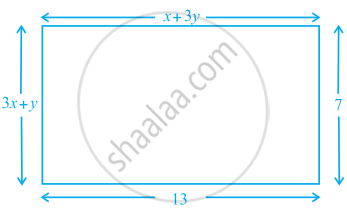
Solve the following system of equations:
11x + 15y + 23 = 0
7x – 2y – 20 = 0
Solve the following system of equations:
`x/2 + y = 0.8`
`7/(x + y/2) = 10`
Solve the following system of equations:
`x/3 + y/4 =11`
`(5x)/6 - y/3 = -7`
Solve the following system of equations:
`4/x + 3y = 8`
`6/x - 4y = -5`
Solve the following system of equations:
`3x - (y + 7)/11 + 2 = 10`
`2y + (x + 11)/7 = 10`
Solve the following system of equations:
`4/x + 3y = 14`
`3/x - 4y = 23`
Solve the following system of equations:
`2/x + 3/y = 13`
`5/x - 4/y = -2`
Solve the following system of equations:
`2/sqrt(x) + 3/sqrt(y) = 2`
`4/sqrt(x) - 9/sqrt(y) = -1`
BASED ON LOTS
Solve the following system of equations:
0.5x + 0.7y = 0.74
0.3x + 0.5y = 0.5
Solve the following system of equations:
`sqrt(2)x - sqrt(3)y = 0`
`sqrt(3)x - sqrt(8)y = 0`
Solve the following system of equations:
`(xy)/(x + y) = 6/5`
`(xy)/(y - x) = 6`
Solve the following system of equations:
`x + y = 2xy`
`(x - y)/(xy) = 6`
Solve the following system of equations:
`44/(x + y) + 30/(x - y) = 10`
`55/(x + y) + 40/(x - y) = 13`
Solve the following system of equations:
`5/(x - 1) + 1/(y - 2) = 2`
`6/(x - 1) - 3/(y - 2) = 1`
Solve the following system of equations:
`10/(x + y) + 2/(x - y) = 4`
`15/(x + y) - 9/(x - y) = -2`
Solve the following system of equations:
`1/(3x + y) + 1/(3x - y) = 3/4`
`1/(2(3x + y)) - 1/(2(3x - y)) = -1/8`
Solve the following system of equations:
`(7x - 2y)/(xy) = 5`
`(8x + 7y)/(xy) = 15`
Solve the following system of equations:
152x – 378y = –74
–378x + 152y = –604
Solve the following system of equations:
99x + 101y = 499
101x + 99y = 501
Solve the following system of equations:
21x + 47y = 110
47x + 21y = 162
Solve the following system of equations algebraically:
30x + 44y = 10; 40x + 55y = 13
Solve the following system of equations algebraically:
37x + 63y = 137
63x + 37y = 163
Solve the following system of equations algebraically:
73x − 37y = 109
37x − 73y = 1
Solve the following system of equations:
`sqrt(2)x + sqrt(3)y = 5`
`sqrt(3)x - sqrt(8)y = -sqrt(6)`
Solve the following system of equations:
101x + 102y = 304
102x + 101y = 305
BASED ON HOTS
If (x + 1) is a factor of 2x3 + ax2 + 2bx + 1, then find the values of a and b given that 2a – 3b = 4.
Find the solution of the pair of equations `x/10 + y/5 - 1 = 0` and `x/8 + y/6 = 15`. Hence, find λ, if y = λx + 5.
Write an equation of a line passing through the point representing solution of the pair of linear equations x + y = 2 and 2x – y = 1. How many such lines can we find?
Write a pair of linear equations which has the unique solution x = –1, y = 3. How many such pairs can you write?
R.D. Sharma solutions for मैथमैटिक्स [अंग्रेजी] कक्षा १० 3 Pair of Linear Equations in Two Variables EXERCISE 3.4 [Page 3.37]
BASIC
Solve the following system of equations by the method of cross-multiplication:
3x + 2y + 25 = 0
2x + y + 10 = 0
Solve the following system of equations by the method of cross-multiplication:
`(x + y)/(xy) = 2`
`(x - y)/(xy) = 6`
Solve the following system of equations by the method of cross-multiplication:
ax + by = a – b
bx – ay = a + b
Solve the following system of equations by the method of cross-multiplication:
ax + by = a2
bx + ay = b2
Solve the following system of equations by the method of cross-multiplication:
`57/(x + y) + 6/(x - y) = 5`
`38/(x + y) + 21/(x - y) = 9`
Solve the following system of equations by the method of cross-multiplication:
5ax + 6by = 28
3ax + 4by = 18
BASED ON LOTS
Solve the following system of equations by the method of cross-multiplication:
mx – ny = m2 + n2
x + y = 2m
Solve the following system of equations by the method of cross-multiplication:
`b/a x + a/b y = a^2 + b^2`
x + y = 2ab
Solve the following system of equations by the method of cross-multiplication:
`(ax)/b - (by)/a = a + b`
ax – by = 2ab
Solve the following system of equations by the method of cross-multiplication:
`\frac{x}{a} + \frac{y}{b} = a + b; \frac{x}{a^{2}} + \frac{y}{b^{2}} = 2`
Solve the following system of equations by the method of cross-multiplication:
`x/a = y/b`
ax + by = a2 + b2
Solve the following system of equations by the method of cross-multiplication:
`a^2/x - b^2/y = 0`
`(a^2b)/x + (b^2a)/y = a + b, x, y != 0`
Solve the following system of equations by the method of cross-multiplication:
`ax + by = (a + b)/2`
3x + 5y = 4
Solve the following system of equations by the method of cross-multiplication:
2(ax – by) + a + 4b = 0
2(bx + ay) + b – 4a = 0
Solve the following system of equations by the method of cross-multiplication:
(a + 2b)x + (2a – b)y = 2
(a – 2b)x + (2a + b)y = 3
Solve the following system of equations by the method of cross-multiplication:
`(a - b)x + (a + b)y = 2a^2 - 2b^2`
(a + b)(x + y) = 4ab
Solve the following system of equations by the method of cross-multiplication:
bx + cy = a + b
`ax(1/(a - b) - 1/(a + b)) + cy(1/(b - a) - 1/(b + a)) = (2a)/(a + b)`
R.D. Sharma solutions for मैथमैटिक्स [अंग्रेजी] कक्षा १० 3 Pair of Linear Equations in Two Variables EXERCISE 3.5 [Pages 3.47 - 3.48]
BASIC
In the following system of equations determine whether the system has a unique solution, no solution or infinitely many solutions. In case there is a unique solution, find it:
x – 3y = 3
3x – 9y = 2
In the following system of equations determine whether the system has a unique solution, no solution or infinitely many solutions. In case there is a unique solution, find it:
2x + y – 5 = 0
4x + 2y – 10 = 0
Find the value of k for which the following system of equations has a unique solution:
kx + 2y = 5
3x + y = 1
Find the value of k for which the following system of equations has a unique solution:
4x + ky + 8 = 0
2x + 2y + 2 = 0
Find the value of k for which the following system of equations have infinitely many solution:
2x + 3y = 2
(k + 2)x + (2k + 1)y = 2(k – 1)
Find the value of k for which the following system of equations have infinitely many solution:
x + (k + 1)y = 4
(k + 1)x + 9y = 5k + 2
Find the value of k for which the following system of equations have infinitely many solution:
2x + (k – 2)y = k
6x + (2k – 1)y = 2k + 5
Find the value of k for which the following system of equations have infinitely many solution:
2x + 3y = 7
(k + 1)x + (2k – 1)y = 4k + 1
Find the value of k for which the following system of equations has no solution:
2x + ky = 11
5x – 7y = 5
Find the value of k for which the following system of equations has no solution:
kx + 3y = k – 3
12x + ky = 6
Find the value of k for which the following system of equations has no solution:
kx + 3y = k – 3
12x + ky = k
Find c if the system of equations cx + 3y + (3 – c) = 0; 12x + cy – c = 0 has infinitely many solutions?
Find the values of k for which the system
2x + ky = 1
3x – 5y = 7
will have (i) a unique solution, and (ii) no solution. Is there a value of k for which the system has infinitely many solutions?
For what value of k, the following system of equations will represent the coincident lines?
x + 2y + 7 = 0
2x + ky + 14 = 0
Determine the values of a and b so that the following system of linear equations have infinitely many solutions:
(2a – 1)x + 3y – 5 = 0
3x + (b – 1)y – 2 = 0
For which value(s) of λ, do the pair of linear equations λx + y = λ2 and x + λy = 1 have no solution?
For which value(s) of λ, do the pair of linear equations λx + y = λ2 and x + λy = 1 have infinitely many solutions?
For which value(s) of λ, do the pair of linear equations λx + y = λ2 and x + λy = 1 have a unique solution?
Find the values of a and b for which the following system of equations has infinitely many solutions:
(2a – 1)x – 3y = 5
3x + (b – 2)y = 3
Find the values of a and b for which the following system of equations has infinitely many solutions:
2x – 3y = 7
(a + b)x – (a + b – 3)y = 4a + b
Find the values of a and b for which the following system of equations has infinitely many solutions:
2x + 3y = 7
(a – b)x + (a + b)y = 3a + b – 2
Find the values of a and b for which the following system of equations has infinitely many solutions:
2x + 3y – 7 = 0
(a – 1)x + (a + 1)y = (3a – 1)
Find the values of a and b for which the following system of equations has infinitely many solutions:
x + 2y = 1
(a – b)x + (a + b)y = a + b – 2
Find the values of a and b for which the following system of equations has infinitely many solutions:
2x + 3y = 7
2ax + ay = 28 – by
R.D. Sharma solutions for मैथमैटिक्स [अंग्रेजी] कक्षा १० 3 Pair of Linear Equations in Two Variables EXERCISE 3.6 [Pages 3.50 - 3.51]
BASIC
7 audio cassettes and 3 video cassettes cost Rs 1110, while 5 audio cassettes and 4 video cassettes cost Rs 1350. Find the cost of an audio cassette and a video cassette.
Reena has pens and pencils which together are 40 in number. If she has 5 more pencils and 5 less pens, then the number of pencils would become 4 times the number of pens. Find the original number of pens and pencils.
Form the pair of linear equations for the following problem and find their solution by substitution method.
The coach of a cricket team buys 7 bats and 6 balls for ₹ 3800. Later, she buys 3 bats and 5 balls for ₹ 1750. Find the cost of each bat and each ball.
BASED ON LOTS
Form the pair of linear equation in the following problem, and find its solution (if they exist) by the elimination method:
A lending library has a fixed charge for the first three days and an additional charge for each day thereafter. Saritha paid Rs 27 for a book kept for seven days, while Susy paid Rs 21 for the book she kept for five days. Find the fixed charge and the charge for each extra day.
Jamila sold a table and a chair for ₹ 1050, thereby making a profit of 10% on a table and 25% on the chair. If she had taken a profit of 25% on the table and 10% on the chair she would have got ₹ 1065. Find the cost price of each.
Susan invested certain amount of money in two schemes A and B, which offer interest at the rate of 8% per annum and 9% per annum, respectively. She received Rs 1860 as annual interest. However, had she interchanged the amount of investments in the two schemes, she would have received Rs 20 more as annual interest. How much money did she invest in each scheme?
The cost of 4 pens and 4 pencil boxes is Rs 100. Three times the cost of a pen is Rs 15 more than the cost of a pencil box. Form the pair of linear equations for the above situation. Find the cost of a pen and a pencil box.
Vijay had some bananas, and he divided them into two lots A and B. He sold the first lot at the rate of Rs 2 for 3 bananas and the second lot at the rate of Re 1 per banana, and got a total of Rs 400. If he had sold the first lot at the rate of Re 1 per banana, and the second lot at the rate of Rs 4 for 5 bananas, his total collection would have been Rs 460. Find the total number of bananas he had.
The cost of 2 kg apples and 1 kg of grapes on a day was found to be ₹ 320. The cost of 4 kg apples and 2 kg grapes was found to be ₹ 600. If cost of 1 kg of apples and 1 kg of grapes is ₹ x and ₹ y respectively, represent the given situation algebraically as a system of equations and check whether the system so obtained is consistent or not.
OR
Solve for x and y:
`sqrt(2)x + sqrt(3)y = 5` and `sqrt(3)x + sqrt(8)y = -sqrt(6)`
BASED ON HOTS
One says, “Give me a hundred, friend! I shall then become twice as rich as you.” The other replies, “If you give me ten, I shall be six times as rich as you.” Tell me what is the amount of their respective capital?
A and B each have a certain number of mangoes. A says to B, “if you give 30 of your mangoes, I will have twice as many as left with you.” B replies, “if you give me 10, I will have thrice as many as left with you.” How many mangoes does each have?
R.D. Sharma solutions for मैथमैटिक्स [अंग्रेजी] कक्षा १० 3 Pair of Linear Equations in Two Variables EXERCISE 3.7 [Page 3.55]
BASIC
Half of the difference of two numbers is 2. The sum of the greater number and twice the smaller number is 13. Find the numbers.
A number consist of two digits whose sum is five. When the digits are reversed, the number becomes greater by nine. Find the number.
The sum of digits of a two number is 15. The number obtained by reversing the order of digits of the given number exceeds the given number by 9. Find the given number.
The sum of two numbers is 1000 and the difference between their squares is 256,000. Find the numbers.
A two-digit number is 4 times the sum of its digits. If 18 is added to the number, the digits are reversed. Find the number.
BASED ON LOTS
The sum of a two-digit number and the number formed by reversing the order of digit is 66. If the two digits differ by 2, find the number. How many such numbers are there?
A two-digit number is 4 times the sum of its digits and twice the product of the digits. Find the number.
A two-digit number is such that the product of its digits is 20. If 9 is added to the number, the digits interchange their places. Find the number.
Form the pair of linear equation in the following problem, and find its solution (if they exist) by the elimination method:
The sum of the digits of a two-digit number is 9. Also, nine times this number is twice the number obtained by reversing the order of the digits. Find the number.
Two numbers are in the ratio 5 : 6. If 8 is subtracted from each of the numbers, the ratio becomes 4 : 5. Find the numbers.
A two-digit number is obtained by either multiplying the sum of the digits by 8 and then subtracting 5 or by multiplying the difference of the digits by 16 and then adding 3. Find the number.
R.D. Sharma solutions for मैथमैटिक्स [अंग्रेजी] कक्षा १० 3 Pair of Linear Equations in Two Variables EXERCISE 3.8 [Page 3.57]
BASIC
The numerator of a fraction is 4 less than the denominator. If the numerator is decreased by 2 and denominator is increased by 1, then the denominator is eight times the numerator. Find the fraction.
Form the pair of linear equations for the following problem and find their solution by substitution method.
A fraction becomes `9/11` if 2 is added to both the numerator and the denominator. If 3 is added to both the numerator and the denominator it becomes `5/6`. Find the fraction.
Form the pair of linear equation in the following problem, and find its solution (if they exist) by the elimination method:
If we add 1 to the numerator and subtract 1 from the denominator, a fraction reduces to 1. It becomes `1/2` if we only add 1 to the denominator. What is the fraction?
The sum of the numerator and denominator of a fraction is 12. If the denominator is increased by 3, the fraction becomes `1/2`. Find the fraction
When 3 is added to the denominator and 2 is subtracted from the numerator a fraction becomes `1/4`. And, when 6 is added to numerator and the denominator is multiplied by 3, it becomes `2/3`. Find the fraction.
A fraction becomes `(1)/(3)` when 2 is subtracted from the numerator and it becomes `(1)/(2)` when 1 is subtracted from the denominator. Find the fraction.
BASED ON LOTS
The sum of the numerator and denominator of a fraction is 4 more than twice the numerator. If the numerator and denominator are increased by 3, they are in the ratio 2 : 3. Determine the fraction.
If the numerator of a fraction is multiplied by 2 and the denominator is reduced by 5 the fraction becomes `6/5`. And, if the denominator is doubled and the numerator is increased by 8, the fraction becomes `2/5`. Find the fraction.
The sum of the numerator and denominator of a fraction is 3 less than twice the denominator. If the numerator and denominator are decreased by 1, the numerator becomes half the denominator. Determine the fraction.
R.D. Sharma solutions for मैथमैटिक्स [अंग्रेजी] कक्षा १० 3 Pair of Linear Equations in Two Variables EXERCISE 3.9 [Pages 3.59 - 3.60]
BASIC
Ten years later, A will be twice as old as B and five years ago, A was three times as old as B. What are the present ages of A and B?
Form the pair of linear equation in the following problem, and find its solutions (if they exist) by the elimination method:
Five years ago, Nuri was thrice as old as Sonu. Ten years later, Nuri will be twice as old as Sonu. How old are Nuri and Sonu?
Six years hence a man’s age will be three times the age of his son and three years ago he was nine times as old as his son. Find their present ages.
Ten years ago, a father was twelve times as old as his son and ten years hence, he will be twice as old as his son will be then. Find their present ages.
BASED ON LOTS
Father’s age is three times the sum of age of his two children. After 5 years his age will be twice the sum of ages of two children. Find the age of father.
Two years ago, a father was five times as old as his son. Two year later, his age will be 8 more than three times the age of the son. Find the present ages of father and son.
The ages of two friends Ani and Biju differ by 3 years. Ani’s father Dharam is twice as old as Ani and Biju is twice as old as his sister Cathy. The ages of Cathy and Dharam differ by 30 years. Find the ages of Ani and Biju.
Two years ago, Salim was thrice as old as his daughter and six years later, he will be four years older than twice her age. How old are they now?
The age of the father is twice the sum of the ages of his two children. After 20 years, his age will be equal to the sum of the ages of his children. Find the age of the father.
Three years ago, Rashmi was thrice as old as Nazma. Ten years later, Rashmi will be twice as old as Nazma. How old are Rashmi and Nazma now?
16 years ago, at the time of marriage, Ajay was 5 years elder to his wife. The present ages of the wife and Ajay are in the ratio 8 : 9. Find their ages at the time of their marriage.
R.D. Sharma solutions for मैथमैटिक्स [अंग्रेजी] कक्षा १० 3 Pair of Linear Equations in Two Variables EXERCISE 3.10 [Pages 3.66 - 3.67]
BASIC
Two people are 16 km apart on a straight road. They start walking at the same time. If they walk towards each other with different speeds, they will meet in 2 hours. Had they walked in the same direction with same speeds as before, they would have met in 8 hours. Find their walking speeds.
A boat goes 30 km upstream and 44 km downstream in 10 hours. In 13 hours, it can go 40 km upstream and 55 km downstream. Determine the speed of the stream and that of the boat in still water.
A person rowing at the rate of 5 km/h in still water, takes thrice as much time in going 40 km upstream as in going 40 km downstream. Find the speed of the stream.
A man travels 600 km partly by train and partly by car. If he covers 400 km by train and the rest by car, it takes him 6 hours and 30 minutes. But, if he travels 200 km by train and the rest by car, he takes half an hour longer. Find the speed of the train and that of the car.
Ritu can row downstream 20 km in 2 hours and upstream 4 km in 2 hours. Find her speed of rowing in still water and the speed of the current.
A motor boat can travel 30 km upstream and 28 km downstream in 7 hours. It can travel 21 km upstream and return in 5 hours. Find the speed of the boat in still water and the speed of the stream.
Abdul travelled 300 km by train and 200 km by taxi taking 5 hours and 30 minutes. But, if he travels 260 km by train and 240 km by taxi, he takes 6 minutes longer. Find the speed of the train and that of taxi.

Form the pair of linear equations in the following problems and find their solutions (if they exist) by any algebraic method:
Places A and B are 100 km apart on a highway. One car starts from A and another from B at the same time. If the cars travel in the same direction at different speeds, they meet in 5 hours. If they travel towards each other, they meet in 1 hour. What are the speeds of the two cars?
BASED ON LOTS
A train covered a certain distance at a uniform speed. If the train could have been 10 km/hr faster, it would have taken 2 hours less than the scheduled time. And if the train were slower by 10 km/hr; it would have taken 3 hours more than the scheduled time. Find the distance covered by the train.
While covering a distance of 30 km. Ajeet takes 2 hours more than Amit. If Ajeet doubles his speed, he would take 1 hour less than Amit. Find their speeds of walking.
A man walks a certain distance with certain speed. If he walks `1/2` km an hour faster, he takes 1 hour less. But, if he walks 1 km an hour slower, he takes 3 more hours. Find the distance covered by the man and his original rate of walking.
R.D. Sharma solutions for मैथमैटिक्स [अंग्रेजी] कक्षा १० 3 Pair of Linear Equations in Two Variables EXERCISE 3.11 [Pages 3.73 - 3.75]
BASIC
The students of a class are made to stand equally in rows. If 3 students are extra in each row, there would be 1 row less. If 3 students are less in a row, there would be 2 more rows. Find the number of students in the class.
The perimeter of a rectangle is 70 cm. The length of the rectangle is 5 cm more than twice its breadth. Express the given situation as a system of linear equations in two variables and hence solve it.
In a rectangle, if the length is increased by 3 metres and breadth is decreased by 4 metres, the area of the rectangle is reduced by 67 square metres. If length is reduced by 1 metre and breadth is increased by 4 metres, the area is increased by 89 sq. metres. Find the dimensions of the rectangle.
ABCD is a cyclic quadrilateral such that ∠A = (4y + 20)°, ∠B = (3y − 5)°, ∠C = (4x)° and ∠D = (7x + 5)°. Find the four angles
Form the pair of linear equations in the following problems and find their solutions (if they exist) by any algebraic method:
Yash scored 40 marks in a test, getting 3 marks for each right answer and losing 1 mark for each wrong answer. Had 4 marks been awarded for each correct answer and 2 marks been deducted for each incorrect answer, then Yash would have scored 50 marks. How many questions were there in the test?
The car hire charges in a city comprise of a fixed charges together with the charge for the distance covered. For a journey of 12 km, the charge paid is ₹ 89 and for a journey of 20 km, the charge paid is ₹ 145. What will a person have to pay for travelling a distance of 30 km?
A part of monthly hostel charges in a college are fixed and the remaining depend on the number of days one has taken food in the mess. When a student A takes food for 20 days, he has to pay ₹ 1000 as hostel charges whereas a student B, who takes food for 26 days, pays ₹ 1180 as hostel charges. Find the fixed charge and the cost of food per day.
Form the pair of linear equations for the following problem and find their solution by substitution method.
The larger of two supplementary angles exceeds the smaller by 18 degrees. Find them.
Form the pair of linear equation in the following problem, and find its solution (if they exist) by the elimination method:
Meena went to a bank to withdraw ₹ 2000. She asked the cashier to give her ₹ 50 and ₹ 100 notes only. Meena got 25 notes in all. Find how many notes of ₹ 50 and ₹ 100 she received.
A shopkeeper gives books on rent for reading. She takes a fixed charge for the first two days, and an additional charge for each day thereafter. Latika paid Rs 22 for a book kept for six days, while Anand paid Rs 16 for the book kept for four days. Find the fixed charges and the charge for each extra day.
In a pair of supplementary angles, the greater angle exceeds the smaller by 50°. Express the given situation as a system of linear equations in two variables and hence obtain the measure of each angle.
A bag contains some red and blue balls. Ten percent of the red balls, when added to twenty percent of the blue balls, give a total of 24. If three times the number of red balls exceeds the number of blue balls by 20, find the number of red and blue balls.
BASED ON LOTS
Formulate the following problems as a pair of equations, and hence find their solutions:
2 women and 5 men can together finish an embroidery work in 4 days, while 3 women and 6 men can finish it in 3 days. Find the time taken by 1 woman alone to finish the work, and also that taken by 1 man alone.
There are two examination rooms A and B. If 10 candidates are sent from A to B, the number of students in each room is same. If 20 candidates are sent from B to A, the number of students in A is double the number of students in B. Find the number of students in each room.
A railway half ticket costs half the full fare and the reservation charge is the same on half ticket as on full ticket. One reserved first class ticket from Mumbai to Ahmedabad costs ₹ 216 and one full and one half reserved first class tickets cost ₹ 327. What is the basic first class full fare and what is the reservation charge?
A shopkeeper sells a saree at 8% profit and a sweater at 10% discount, thereby, getting a sum Rs 1008. If she had sold the saree at 10% profit and the sweater at 8% discount, she would have got Rs 1028. Find the cost price of the saree and the list price (price before discount) of the sweater.
In a competitive examination, one mark is awarded for each correct answer while `1/2` mark is deducted for every wrong answer. Jayanti answered 120 questions and got 90 marks. How many questions did she answer correctly?
Tara scored 40 marks in a test, getting 3 marks for each right answer and losing 1 mark for each wrong answer. Had 4 marks been awarded for each correct answer and 2 marks been deducted for each wrong answer, then Tara would have scored 50 marks. Assuming that Tara attempted all question, find the total number of questions in the test.
The two angles of a right angled triangle other than 90° are in the ratio 2 : 3. Express the given situation algebraically as a system of linear equations in two variables and hence solve it.
The perimeter of an isosceles triangle is 32 cm. If each equal side is `5/6` th of the base, find the area of the triangle.
R.D. Sharma solutions for मैथमैटिक्स [अंग्रेजी] कक्षा १० 3 Pair of Linear Equations in Two Variables VERY SHORT ANSWER TYPE QUESTIONS (VSAQS) [Pages 3.75 - 3.76]
Answer each of the following questions either in one word or one sentence or as per requirement of the questions:
BASIC
Write the value of k for which the system of equations x + y – 4 = 0 and 2x + ky – 3 = 0 has no solution.
Write the value of k for which the system of equations
2x – y = 5
6x + ky = 15
has infinitely many solutions.
Write the value of k for which the system of equations 3x – 2y = 0 and kx + 5y = 0 has infinitely many solutions.
Write the values of k for which the system of equations x + ky = 0, 2x – y = 0 has unique solution.
BASED ON LOTS
Write the set of values of a and b for which the following system of equations has infinitely many solutions.
2x + 3y = 7
2ax + (a + b)y = 28
For what value of k, the following pair of linear equations has infinitely many solutions?
10x + 5y – (k – 5) = 0
20x + 10y – k = 0
Write the number of solutions of the following pair of linear equations:
x + 2y – 8 = 0
2x + 4y = 16
Write the number of solutions of the following pair of linear equations:
x + 3y – 4 = 0, 2x + 6y – 7 = 0
If 2x + y = 13 and 4x – y = 17, find the value of (x – y).
Sum of two numbers is 105 and their difference is 45. Find the numbers.
Solve for x and y:
23x + 24y = 23
24x + 23y = 24
R.D. Sharma solutions for मैथमैटिक्स [अंग्रेजी] कक्षा १० 3 Pair of Linear Equations in Two Variables FILL IN THE BLANK TYPE QUESTIONS (FBQs) [Page 3.76]
BASIC
The pair of equations y = 0 and y = –7 has ______ solution.
The pair of equations x = a and y = b has ______ solution.
If the pair of equations 3x + 2ky = 2 and 2x + 5y + 1 = 0 has no solution, then k = ______.
If a pair of linear equations is consistent, then the lines representing them are either ______ or ______.
There is (are) ______ value(s) of c for which the pair of equations cx – y = 2 and 6x – 2y = 3 have infinitely many solutions.
If a pair of linear equations is consistent with a unique solution, then the lines representing them are ______.
The pair of equations λx + 3y = 7, 2x + 6y = 14 will have infinitely many solutions for λ = ______.
If the pair of equations 2x + 3y – 5 = 0 and px – 6y – 8 = 0 has a unique solution for all real values of p except ______.
If the lines represented by the equations 3x – y – 5 = 0 and 6x – 2y – p = 0 are parallel, then p is equal to ______.
If x = a, y = b is the solution of the pair of equations x – y = 2 and x + y = 4, then a = and b = ______.
BASED ON LOTS
If one equation of a pair of dependent linear equations is 5x – 7y + 2 = 0, then the second equation is given by ______.
If the pair of equations ax + 2y = 7 and 3x + by = 16 represent parallel lines, then ab = ______.
The line 4x + 3y – 12 = 0 cuts the coordinate axes at A and B. The area of ΔOAB is ______.
If `2^(x + y) = 2x - y = sqrt(8)`, then x = ______ and y = ______.
The system of equations ax + 3y = 1, –12x + ay = 2 has ______ for all real values of a.
Solutions for 3: Pair of Linear Equations in Two Variables
R.D. Sharma solutions for मैथमैटिक्स [अंग्रेजी] कक्षा १० chapter 3 - Pair of Linear Equations in Two Variables
Shaalaa.com has the CBSE, Karnataka Board Mathematics मैथमैटिक्स [अंग्रेजी] कक्षा १० CBSE, Karnataka Board solutions in a manner that help students grasp basic concepts better and faster. The detailed, step-by-step solutions will help you understand the concepts better and clarify any confusion. R.D. Sharma solutions for Mathematics मैथमैटिक्स [अंग्रेजी] कक्षा १० CBSE, Karnataka Board 3 (Pair of Linear Equations in Two Variables) include all questions with answers and detailed explanations. This will clear students' doubts about questions and improve their application skills while preparing for board exams.
Further, we at Shaalaa.com provide such solutions so students can prepare for written exams. R.D. Sharma textbook solutions can be a core help for self-study and provide excellent self-help guidance for students.
Concepts covered in मैथमैटिक्स [अंग्रेजी] कक्षा १० chapter 3 Pair of Linear Equations in Two Variables are .
Using R.D. Sharma मैथमैटिक्स [अंग्रेजी] कक्षा १० solutions Pair of Linear Equations in Two Variables exercise by students is an easy way to prepare for the exams, as they involve solutions arranged chapter-wise and also page-wise. The questions involved in R.D. Sharma Solutions are essential questions that can be asked in the final exam. Maximum CBSE, Karnataka Board मैथमैटिक्स [अंग्रेजी] कक्षा १० students prefer R.D. Sharma Textbook Solutions to score more in exams.
Get the free view of Chapter 3, Pair of Linear Equations in Two Variables मैथमैटिक्स [अंग्रेजी] कक्षा १० additional questions for Mathematics मैथमैटिक्स [अंग्रेजी] कक्षा १० CBSE, Karnataka Board, and you can use Shaalaa.com to keep it handy for your exam preparation.
