Solve the following system of equations by the method of cross-multiplication: ax + by = a – b bx – ay = a + b
Advertisements
प्रश्न
Solve the following system of equations by the method of cross-multiplication:
ax + by = a – b
bx – ay = a + b
Using cross-multiplication method, solve the following system of simultaneous linear equations:
ax + by = a – b, bx – ay = a + b
Advertisements
उत्तर
The given system of equations is
ax + by = a – b ...(i)
bx – ay = a + b ...(ii)
Here
a1 – a, b1 = b, c1 = b – a
a2 = b, b2 = –a, c2 = –a – b
By cross multiplication, we get
⇒ `x/((-a - b) xx (b) - (b - a) xx (-a))`
= `(-y)/((-a - b) xx (a) - (b - a) xx (-b))`
= `1/(-a xx a - b xx b)`
⇒ `x/(-ab - b^2 + ab - a^2)`
= `(-y)/(-a^2 - ab - b^2 + ab)`
= `1/(-a^2 - b^2)`
⇒ `x/(-b^2 - a^2) = (-y)/(-a^2 - b^2) = 1/(-a^2 - b^2)`
Now
`x/(-b^2 - a^2) = 1/(-a^2 - b^2)`
⇒ `x = (-b^2 - a^2)/(-a^2 - b^2)`
= `(-(b^2 + a^2))/(a^2 + b^2)`
= `(a^2 + b^2)/(a^2 + b^2)`
⇒ x = 1
`(-y)/(-a^2 -b^2) = 1/(-a^2-b^2)`
⇒ `-y = (-(a^2 + b^2))/(-(a^2 + b^2))`
⇒ –y = 1
⇒ y = –1
Hence, x = 1, y = –1 is the solution of the given system of equations.
संबंधित प्रश्न
A motorboat whose speed in still water is 18 km/h, takes 1 hour more to go 24 km upstream than to return downstream to the same spot. Find the speed of the stream.
Solve the follownig system of equations by the method of cross-multiplication.
2x – 6y + 10 = 0
3x – 7y + 13 = 0
Solve the following system of equations in x and y by cross-multiplication method
`(a – b) x + (a + b) y = a^2 – 2ab – b^2`
`(a + b) (x + y) = a^2 + b^2`
Solve the following system of equations by cross-multiplications method.
`a(x + y) + b (x – y) = a^2 – ab + b^2`
`a(x + y) – b (x – y) = a^2 + ab + b^2`
Which of the following pairs of linear equations has unique solution, no solution, or infinitely many solutions. In case there is a unique solution, find it by using cross multiplication method.
x – 3y – 7 = 0
3x – 3y – 15 = 0
Solve the following systems of equations:
`x + 2y = 3/2`
`2x + y = 3/2`
Solve each of the following systems of equations by the method of cross-multiplication
`x/a + y/b = 2`
`ax - by = a^2 - b^2`
Solve each of the following systems of equations by the method of cross-multiplication :
`2/x + 3/y = 13`
`5/4 - 4/y = -2`
where `x != 0 and y != 0`
Solve each of the following systems of equations by the method of cross-multiplication
`a^2x + b^2y = c^2`
`b^2x + a^2y = d^2`
Solve each of the following systems of equations by the method of cross-multiplication :
6(ax + by) = 3a + 2b
6(bx - ay) = 3b - 2a
Solve the following system of equations by the method of cross-multiplication:
mx – ny = m2 + n2
x + y = 2m
Solve the system of equations by using the method of cross multiplication:
6x – 5y – 16 = 0, 7x – 13y + 10 = 0
Complete the activity to find the value of x.
3x + 2y = 11 ...(i) and 2x + 3y = 4 ...(ii)
Solution:
Multiply equation (i) by ______ and equation (ii) by ______.
`square` × (3x + 2y = 11) ∴ 9x + 6y = 33 ...(iii)
`square` × (2x + 3y = 4) ∴ 4x + 6y = 8 ...(iv)
Subtract (iv) from (iii),
`square` x = 25
∴ x = `square`
Solve 0.4x + 0.3y = 1.7; 0.7x − 0.2y = 0.8
Find the values of x and y in the following rectangle [see figure].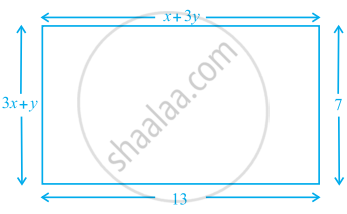
Solve the following pair of equations:
`(2xy)/(x + y) = 3/2, (xy)/(2x - y) = (-3)/10, x + y ≠ 0, 2x - y ≠ 0`
In a competitive examination, one mark is awarded for each correct answer while `1/2` mark is deducted for every wrong answer. Jayanti answered 120 questions and got 90 marks. How many questions did she answer correctly?
Susan invested certain amount of money in two schemes A and B, which offer interest at the rate of 8% per annum and 9% per annum, respectively. She received Rs 1860 as annual interest. However, had she interchanged the amount of investments in the two schemes, she would have received Rs 20 more as annual interest. How much money did she invest in each scheme?
For what values of k will the following pair of linear equations have infinitely many solutions?
kx + 3y – (k – 3) = 0
12x + ky – k = 0
Anuj had some chocolates, and he divided them into two lots A and B. He sold the first lot at the rate of ₹ 2 for 3 chocolates and the second lot at the rate of ₹ 1 per chocolate, and got a total of ₹ 400. If he had sold the first lot at the rate of ₹ 1 per chocolate, and the second lot at the rate of ₹4 for 5 chocolates, his total collection would have been ₹460. Find the total number of chocolates he had.
