Advertisements
Advertisements
प्रश्न
Solve each of the following systems of equations by the method of cross-multiplication :
2x + y = 35
3x + 4y = 65
Advertisements
उत्तर
The given system of equations may be written as
2x + y - 35 = 0
3x + 4y - 65 = 0
Here
`a_1 = 2, b_1 = 1, c_1 = -35`
`a_2 = 3, b_2 = 4, and c_2 = -65`
By cross multiplication, we have
`=> x/(1xx (-65) - (-35) xx 4) = (-y)/(2xx(-65)-(-35)xx3) = 1/(2xx4 - 1xx3)`
`=> x/(-65 + 140) = (-y)/(-130 + 105) = 1/(8 -3)`
`=> x/75 = (-y)/(-25) = 1/5`
`=> x/75 = y/25 = 1/5`
Now
`y/25 = 1/5`
`=> y = 25/5 =5`
Hence, x = 15, y = 5is the solution of the given system of equations.
संबंधित प्रश्न
Solve the following system of equations by cross-multiplication method.
2x + 3y + 8 = 0
4x + 5y + 14 = 0
Solve the following system of equations by cross-multiplication method.
ax + by = a – b; bx – ay = a + b
Which of the following pairs of linear equations has unique solution, no solution, or infinitely many solutions. In case there is a unique solution, find it by using cross multiplication method
x – 3y – 3 = 0
3x – 9y – 2 = 0
Solve the following system of equations:
`x/3 + y/4 =11`
`(5x)/6 - y/3 = -7`
Solve the following system of equations:
`3x - (y + 7)/11 + 2 = 10`
`2y + (x + 11)/7 = 10`
Solve each of the following systems of equations by the method of cross-multiplication :
x + 2y + 1 = 0
2x − 3y − 12 = 0
Solve the following system of equations by the method of cross-multiplication:
3x + 2y + 25 = 0
2x + y + 10 = 0
Solve each of the following systems of equations by the method of cross-multiplication :
`2/x + 3/y = 13`
`5/4 - 4/y = -2`
where `x != 0 and y != 0`
Solve the system of equations by using the method of cross multiplication:
6x – 5y – 16 = 0, 7x – 13y + 10 = 0
Solve the system of equations by using the method of cross multiplication:
2x + y – 35 = 0, 3x + 4y – 65 = 0
Solve the system of equations by using the method of cross multiplication:
`x/6 + y/15 - 4 = 0, x/3 - y/12 - 19/4 = 0`
Solve the system of equations by using the method of cross multiplication:
2ax + 3by – (a + 2b) = 0, 3ax + 2by – (2a + b) = 0
Solve 0.4x + 0.3y = 1.7; 0.7x − 0.2y = 0.8
Find the values of x and y in the following rectangle [see figure].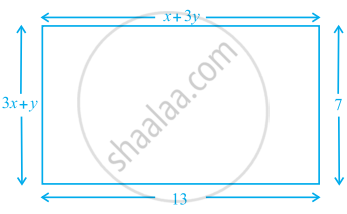
Solve the following pair of equations:
`x/3 + y/4 = 4, (5x)/6 - y/4 = 4`
Solve the following pair of equations:
`1/(2x) - 1/y = -1, 1/x + 1/(2y) = 8, x, y ≠ 0`
Find the solution of the pair of equations `x/10 + y/5 - 1 = 0` and `x/8 + y/6 = 15`. Hence, find λ, if y = λx + 5.
Vijay had some bananas, and he divided them into two lots A and B. He sold the first lot at the rate of Rs 2 for 3 bananas and the second lot at the rate of Re 1 per banana, and got a total of Rs 400. If he had sold the first lot at the rate of Re 1 per banana, and the second lot at the rate of Rs 4 for 5 bananas, his total collection would have been Rs 460. Find the total number of bananas he had.
For what values of k will the following pair of linear equations have infinitely many solutions?
kx + 3y – (k – 3) = 0
12x + ky – k = 0
Anuj had some chocolates, and he divided them into two lots A and B. He sold the first lot at the rate of ₹ 2 for 3 chocolates and the second lot at the rate of ₹ 1 per chocolate, and got a total of ₹ 400. If he had sold the first lot at the rate of ₹ 1 per chocolate, and the second lot at the rate of ₹4 for 5 chocolates, his total collection would have been ₹460. Find the total number of chocolates he had.
