Find the solution of the pair of equations x/10 + y/5 – 1 = 0 and x/8 + y/6 = 15. Hence, find λ, if y = λx + 5.
Advertisements
प्रश्न
Find the solution of the pair of equations `x/10 + y/5 - 1 = 0` and `x/8 + y/6 = 15`. Hence, find λ, if y = λx + 5.
Advertisements
उत्तर
Given pair of equations is
`x/10 + y/5 - 1` = 0
⇒ x + 2y – 10 = 0 ......(i)
⇒ x + 2y = 10
And `x/8 + y/6` = 15
⇒ 3x + 4y = 360 ......(ii)
On multiplying equation (i) by 2 and then subtracting from equation (ii), we get
(3x + 4y) – (2x + 4y) = 360 – 20
⇒ x = 340
Put the value of x in equation (i), we get
340 + 2y = 10
⇒ 2y = 10 – 340 = –330
⇒ y = –165
Now, y = λx + 5
Put the values of x and y in above relation, we get
–165 = λ(340) + 5
⇒ 340λ = –170
⇒ λ = `- 1/2`
Hence, the solution of the pair of equations are x = 340, y = –165 and the required value of λ is `- 1/2`.
संबंधित प्रश्न
Solve the following system of equations by cross-multiplication method x + y = a – b; ax – by = a2 + b2
Solve the following system of equations by cross-multiplication method ax + by = 1; `bx + ay = \frac{(a+b)^{2}}{a^{2}+b^{2}-1`
Solve the following system of equations by cross-multiplications method.
`a(x + y) + b (x – y) = a^2 – ab + b^2`
`a(x + y) – b (x – y) = a^2 + ab + b^2`
Which of the following pairs of linear equations has unique solution, no solution, or infinitely many solutions. In case there is a unique solution, find it by using cross multiplication method
x – 3y – 3 = 0
3x – 9y – 2 = 0
Form the pair of linear equations in the following problems and find their solutions (if they exist) by any algebraic method:
A fraction becomes `1/3` when 1 is subtracted from the numerator and it becomes `1/4` when 8 is added to its denominator. Find the fraction.
Form the pair of linear equations in the following problems and find their solutions (if they exist) by any algebraic method
The area of a rectangle gets reduced by 9 square units, if its length is reduced by 5 units and breadth is increased by 3 units. If we increase the length by 3 units and the breadth by 2 units, the area increases by 67 square units. Find the dimensions of the rectangle.
Solve the following system of equations by the method of cross-multiplication:
3x + 2y + 25 = 0
2x + y + 10 = 0
Solve each of the following systems of equations by the method of cross-multiplication
x + ay = b
ax − by = c
Solve each of the following systems of equations by the method of cross-multiplication
`x/a + y/b = a + b`
Solve each of the following systems of equations by the method of cross-multiplication :
2ax + 3by = a + 2b
3ax + 2by = 2a + b
Solve the following system of equations by the method of cross-multiplication:
`(ax)/b - (by)/a = a + b`
ax – by = 2ab
Solve the system of equations by using the method of cross multiplication:
2x + y – 35 = 0, 3x + 4y – 65 = 0
Solve the system of equations by using the method of cross multiplication:
`5/(x + y) - 2/(x - y) + 1 = 0, 15/(x + y) + 7/(x - y) - 10 = 0`
Complete the activity to find the value of x.
3x + 2y = 11 ...(i) and 2x + 3y = 4 ...(ii)
Solution:
Multiply equation (i) by ______ and equation (ii) by ______.
`square` × (3x + 2y = 11) ∴ 9x + 6y = 33 ...(iii)
`square` × (2x + 3y = 4) ∴ 4x + 6y = 8 ...(iv)
Subtract (iv) from (iii),
`square` x = 25
∴ x = `square`
Find the values of x and y in the following rectangle [see figure].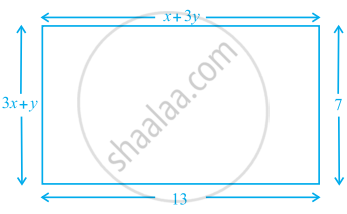
A person rowing at the rate of 5 km/h in still water, takes thrice as much time in going 40 km upstream as in going 40 km downstream. Find the speed of the stream.
A two-digit number is obtained by either multiplying the sum of the digits by 8 and then subtracting 5 or by multiplying the difference of the digits by 16 and then adding 3. Find the number.
Anuj had some chocolates, and he divided them into two lots A and B. He sold the first lot at the rate of ₹ 2 for 3 chocolates and the second lot at the rate of ₹ 1 per chocolate, and got a total of ₹ 400. If he had sold the first lot at the rate of ₹ 1 per chocolate, and the second lot at the rate of ₹4 for 5 chocolates, his total collection would have been ₹460. Find the total number of chocolates he had.
