Advertisements
Advertisements
प्रश्न
The pressure p and volume V of an ideal gas both increase in a process.
(a) Such a process is not possible.
(b) The work done by the system is positive.
(c) The temperature of the system must increase.
(d) Heat supplied to the gas is equal to the change in internal energy.
Advertisements
उत्तर
(b) The work done by the system is positive.
(c) The temperature of the system must increase.
Work done by the system depends on the change in volume during the process (ΔW = pΔV), where p be the pressure and ΔV be the change in volume of the ideal gas. Since in this process the volume is continuously increasing, the work done by the system will be positive.
According to the ideal gas equation, `pV = nRT.`
Since both p and V are increasing, temperature (T ) must also increase.
APPEARS IN
संबंधित प्रश्न
A steam engine delivers 5.4×10⁸ J of work per minute and services 3.6 × 10⁹ J of heat per minute from its boiler. What is the efficiency of the engine? How much heat is wasted per minute?
Can work be done by a system without changing its volume?
When a tyre bursts, the air coming out is cooler than the surrounding air. Explain.
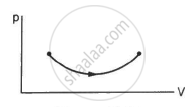
Consider the process on a system shown in figure. During the process, the work done by the system ______________ .
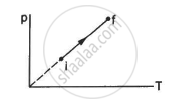
An ideal gas goes from the state i to the state f as shown in figure. The work done by the gas during the process ______________ .
A gas is contained in a metallic cylinder fitted with a piston. The piston is suddenly moved in to compress the gas and is maintained at this position. As time passes the pressure of the gas in the cylinder ______________ .
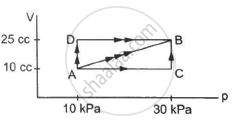
Figure shows three paths through which a gas can be taken from the state A to the state B. Calculate the work done by the gas in each of the three paths.
A system releases 130 kJ of heat while 109 kJ of work is done on the system. Calculate the change in internal energy.
What is the internal energy of the system, when the amount of heat Q is added to the system and the system does not do any work during the process?
Explain the different ways through which the internal energy of the system can be changed.
One gram of water (1 cm3) becomes 1671 cm3 of steam at a pressure of 1 atm. The latent heat of vaporization at this pressure is 2256 J/g. Calculate the external work and the increase in internal energy.
In a thermodynamic system, working substance is ideal gas. Its internal energy is in the form of ______.
8 m3 of a gas is heated at the pressure 105 N/m2 until its volume increases by 10%. Then, the external work done by the gas is ____________.
When 1 g of water at 0° C and 1 x 10⁵ N/m2 pressure is converted into ice of volume 1.082 cm3, the external work done will be ____________.
In insulated systems, the amount of external work done by the gas is proportional to:
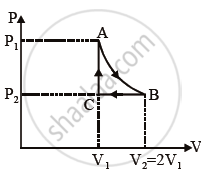
n mole of a perfect gas undergoes a cyclic process ABCA (see figure) consisting of the following processes:
A `→` B: Isothermal expansion at temperature T so that the volume is doubled from V1 to V2 = 2V1 and pressure changes from P1 to P2.
B `→` C: Isobaric compression at pressure P2 to initial volume V1.
C `→` A: Isochoric change leading to change of pressure from P2 to P1.
Total workdone in the complete cycle ABCA is ______.
An expansion process on a diatomic ideal gas (Cv = 5/2 R), has a linear path between the initial and final coordinates on a pV diagram. The coordinates of the initial state are: the pressure is 300 kPa, the volume is 0.08 m3 and the temperature is 390 K. The final pressure is 90 kPa and the final temperature s 320 K. The change in the internal energy of the gas, in SI units, is closest to:
If a gas is compressed adiabatically:
A system releases 125 kJ of heat while 104 kJ work is done on the system. Calculate the change in internal energy.
