Advertisements
Advertisements
प्रश्न
The phrases on the left in the following box occur in the text. Match each of them with a phrase on the right.
| (i) an endless stretch of sand | •fertile place with water and plants in a desert |
| (ii) waterless and without shelter | •not visible because the grass is thick |
| (iii) an oasis | •nothing but sand as far as one can see |
| (iv) hidden by a cover of grass | •no water and no shade |
Advertisements
उत्तर
| (i) an endless stretch of sand | •nothing but sand as far as one can see |
| (ii) waterless and without shelter | • no water and no shade |
| (iii) an oasis | • fertile place with water and plants in a desert |
| (iv) hidden by a cover of grass | •not visible because the grass is thick |
संबंधित प्रश्न
Here are some fact from Einstein’s life. Arrange the in chronological order.
[1 ] Einstein publishes his special theory of relativity.
[2] He is awarded the Nobel Prize in Physics.
[3] Einstein writes a letter to U.S. President, Franklin D. Roosevelt, and warns against
Germany’s building of an atomic bomb.
[4 ] Einstein attends a high school in Munich.
[5 ] Einstein’s family moves to Milan.
[6 ] Einstein is born in the German city of Ulm.
[7 ] Einstein joins a university in Zurich, where he meets Mileva.
[8 ] Einstein dies.
[ 9] He provides a new interpretation of gravity.
[10 ] Tired of the school’s regimentation, Einstein withdraws from school.
[11 ] He works in a patent office as a technical expert.
[12 ] When Hitler comes to power, Einstein leaves Germany for the United States.
This is a meeting of the school’s Parent-Teacher Association. Some student representatives have also been invited to participate to discuss the role that Information technology/computers play in the growth and development of children.
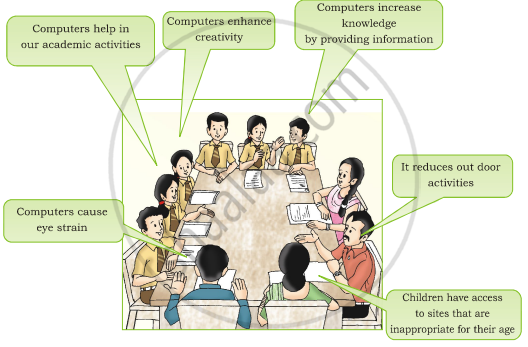
Read the following and share your feelings with the class.
INTROSPECT: Realise Your Potential.
Sixteen year old Shreya, a student of XI, angrily outbursts at her parents and says, "No one likes me".
She has not been able to develop an interest in any activity, be it painting, swimming, games or studying. She is not sure what types of relationships give her comfort.
She has never had a good friend. She is not clear about her choice of career.
Shreya is good-looking, as well as physically healthy. During the interview, she was preoccupied with what others think about her.
When asked to talk about her positive qualities, she thought for a long time but could not list any. Nor was she able to mention her negative aspects.
Self Awareness
Knowing your strengths and weaknesses will help you succeed.
Knowing our helps us in acknowledging our success as well as appreciating our capacity to do something with or without support from others.
This givee us a sense of well being and we are able to learn new skills and develop assets , thereby developing our confidence. Confident people attract friends and other stable relationships.
In due course , we are ready to accept various challenges with the right kind of Investment of energy towarde task completion.
Knowing our weaknesses helps us In accepting our limitations, and developing a willingness to take help when offered and enabling us to overcome our deficits.
This paves way to expansion of skills and qualities, which prove useful ln the long run. It is worthwhile to Introspect and reflect so as to realise our potential . This help to bring about a change in us and we are able to meet challenges .
lf Shreya had introspected or had been helped by her parents or teachers to reflect on herself, she would have understood her positive and negative qualities , her likes , dislike , strengths , weakness , feelings , emotions , outlooks , choices , values and attitude towards life.
self awareness paves the way to pregress with respect to relationships , academic success , professional and personal fulfillment .
Adapted from "The Quest",
The Hindu
“So that is what you are doing out here? A marshal!” “My dear Miss Fairchild,” said ’ Easton, calmly, “I had to do something. Money has & way of taking wings unto itself, and
you know it takes money to keep step with our crowd in Washington. I saw this opening in the West, and—well, a marshalship isn’t quite as high a position as that of ambassador, but—” “The ambassador,” said the girl, warmly, “doesn’t call any more. He needn’t ever have done so. You ought to know that. And so now you are one of these dashing Western heroes, and you ride and shoot and go into all kinds of dangers. That’s different from the Washington life. You have been missed from the old crowd.” The girl’s eyes, fascinated, went back, widening a little, to rest upon the glittering handcuffs. “Don’t you worry about them, miss,” said the other man. “All marshals handcuff themselves to their prisoners to keep them from getting away. Mr. Easton knows his business.” “Will we see you again soon in Washington?” asked the girl. “Not soon, I think,” said Easton. “My butterfly days are over, I fear.”
Read the extract given below and answer the question that follow.
What reason does Easton give for not keeping up with their crowd in Wahington?
What do you think of Antonio and of Shylock 1vi' regard to the signing of the bond?
The following sentence has two blanks. Fill in the blanks with appropriate forms of the word given in brackets.
Asking for_________ is as noble as willingness to________ . (forgive)
Friendship is a great relation. We all must treasure our friends. Explain.
Describe Golu’s meeting with the crocodile.
“The watch was nothing special and yet had great powers.” In what sense did it have ‘great powers’?
Fans don’t talk, but it is possible to imagine that they do. What is it, then, that sounds like the fan’s chatter?
How did Vijay Singh outwit the ghost with his wit and wisdom?
Answer the following question. (Refer to that part of the text whose number is given against the question. This applies to the comprehension questions throughout the book.)
How did Patrick help him? (7)
Mark the right item:
“This, said the emperor, was to encourage all children to honour and obey their parents.”
‘This’ refers to ______
Complete the following sentence.
When the boy started to bring him pieces of cake and biscuit, the squirrel _________
Answer the following question.
Why do you think the writer visited Miss Beam’s school?
Answer the question.
Why does the poet wonder if teachers also do things that other people do?
Multiple Choice Question:
Which one of the following mistakes the child does not make?
Write True or False against the following statement.
Radha’s mother enjoys doing things with her.
In groups of four, discuss the following lines and their meanings.
For many of the loveliest things
Have never yet been said
Read the following extract from Maya Angelou's poem, 'I Know Why the Caged Bird Sings' and answer the questions that follow:
|
But a caged bird stands on the grave of dreams |
- How does Angelou describe the state of the free bird in the opening lines of the poem? [3]
- Give a brief description of the caged bird's physical and mental condition. [3]
- Explain the phrase, 'grave of dreams' in your own words.
What does the caged bird sing about? [3] - The 'free bird' and the 'caged bird' in the poem represent different groups of people. Name them.
Name any one group of people that you would call 'caged birds' in today's world. [3] - What does the title of the poem, 'I Know Why the Caged Bird Sings', tell us about Maya Angelou's life?
Mention two ways in which the world of the caged bird differs from that of the free bird. [4]
