Advertisements
Advertisements
प्रश्न
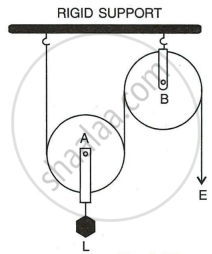
The diagram below shows a pulley arrangement.
- Name the pulleys A and B.
- In the diagram, mark the direction of tension on each strand of string.
- What is the purpose of the pulley B?
- If the tension is T, deduce the relation between
- T and E, and
- E and L.
- What is the velocity ratio of the arrangement?
- Assuming that the efficiency of the system is 100%, what is the mechanical advantage?
Advertisements
उत्तर
- Pulley A is a movable pulley.
Pulley B is a fixed pulley. - Tension T is marked in (f)
-
Pulley B's function is to reverse the direction of effort applied, moving it from upward to downward.
- Relation between:
- T and E are E = T.
- Between E and L, is E = `L/2`
- V.R. = `("Distance moved by effort" d_E)/("Distance moved by load" d_L)`
V.R. = `(2d)/d = 2` - M.A. = Efficiency × V.R.
= `100/100 xx 2 = 2`
APPEARS IN
संबंधित प्रश्न
The mechanical advantage of an actual pulley is less than one. Give a reason. What is the justification for using the pulley then?
Explain the working of a gear system.
Define the following term in reference to a gear system of Driving gear ?
What is a single movable pulley? What is its mechanical advantage in the ideal case?
Differentiate between a single fixed pulley and a single movable pulley.
Draw a diagram of a combination of three movable pulleys and one fixed pulley to lift up a load. In the diagram, show the directions of load, effort and tension in each strand. Find:
- mechanical advantage,
- Velocity ratio and
- efficiency of the combination in ideal situation.
The mechanical advantage of an ideal single movable pulley is ______.
What is a block and tackle system of pulleys?
(a) Fig represents an incomplete diagram of a simple string pulley system. Copy this diagram on a new page and complete it and mark where the effort must be applied to lift the load.
(b) What is the velocity ratio of this system?
(c) If the pulley system is 80% efficient and the load is 720 N, then
(i) What effort must be applied to lift the load?
(ii) What work must be done must be done in lifting the load through a distance of 2 m using this machine?
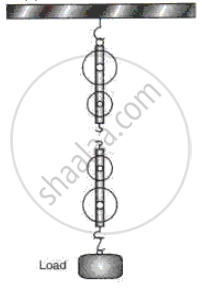
In the alongside the figure of two pulleys shown a system in which one pulley is fixed and the other is movable. What is the velocity ratio of the system?
An effort of 600 N is needed to lift a weight of 1000 N. What are the mechanical advantage and efficiency of the pulley system?
