Advertisements
Advertisements
प्रश्न
| Gamma rays | D | C | Visible light | B | A |
The above table shows different parts of the electromagnetic spectrum.
(a) Identify the parts of the spectrum marked as A, B, C and D.
(b) Which of the radiations A or B has the higher frequency?
(c) State two properties which are common to all parts of the electromagnetic spectrum.
(d) Name one source of each of the radiation of electromagnetic spectrum.
(e) Name one detector for each of the radiation.
(f) Name one use of each of the radiation.
Advertisements
उत्तर
(a) A, B, C and D are microwaves, infrared waves, ultraviolet light and x-rays respectively.
(b) Radiations B (microwaves) have a higher frequency.
(c) Common properties of e-m spectrum:
(i) All electromagnetic waves travel with the same speed in vacuum (or air) which is equal to the speed of light i.e. 3 x 10⁸ m/s.
(ii) These waves are unaffected by the electric and magnetic fields.
(d)
| Name of wave | Source |
| 1. Gamma rays | 1. cosmic rays |
| 2. X rays | 2. When highly energetic electrons are stopped by a heavy metal target of high melting point (x-ray tube) |
|
3. Ultraviolet |
3. Sunlight |
| 4. visible light | 4. White hot bodies |
|
5. Infrared waves |
5. Lamp with thoriated filament. |
| 6. Microwaves |
6. Electronic devices such as klystron tube. |
| 7. Radio waves | 7. Radio transmissions. |
(e)
| Name of waves | Detector |
| 1. Gamma rays | 1. Geiger tube |
| 2. X rays | 2. Photographic film coated with zinc sulphide. |
| 3. Ultraviolet | 3. Photographic plate |
| 4. visible light | 4. Eye photo cells |
| 5. Infrared waves | 5. Thermopile |
| 6. Microwaves | 6. Wave guide tubes |
| 7. Radio waves | 7. Earphone |
(f)
| Name of waves | Use |
| 1. Gamma rays | 1. Detecting flaws in metal casting. |
| 2. X rays | 2. Diffraction to find crystal structure |
| 3. Ultraviolet | 3. Burglar alarms |
| 4. visible light | 4. Photography |
| 5. Infrared waves | 5. Infra - red photography |
| 6. Microwaves | 6. Microwave cooking |
| 7. Radio waves | 7. Communication and navigation. |
APPEARS IN
संबंधित प्रश्न
Identify the part of the electromagnetic spectrum which is suitable for radar system used in aircraft navigation.
What is the range of the wavelength of the following electromagnetic waves?
(a) Visible.
Name the radiations of wavelength shorter than 4 × 10⁻⁷ m.
Which part of electromagnetic spectrum is used in radar systems?
Is it possible that in a Coolidge tube characteristic Lα X-rays are emitted but not Kα X-rays?
Moseley's Law for characteristic X-ray is √v = a(Z − b). Here,
Frequencies of Kα X-rays of different materials are measured. Which one of the graphs in the figure may represent the relation between the frequency v and the atomic number Z ?
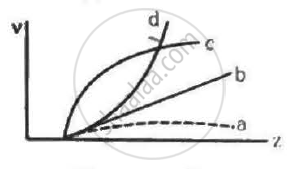
50% of the X-rays coming from a Coolidge tube are able to pass through a 0.1 mm thick aluminium foil. If the potential difference between the target and the filament is increased, the fraction of the X-rays passing through the same foil will be
If λv, λx and λm Am represents the wavelength of visible light, x-ray and microwaves respectively, then ______.
Which electromagnetic radiation has the highest frequency and shortest wavelength?
