Advertisements
Advertisements
प्रश्न
State any two sources of errors in the meter-bridge experiment. Explain how they can be minimized.
Advertisements
उत्तर
The chief sources of error in the meter bridge experiment are as follows:
- The cross-section of the bridge wire may not be uniform. The wire’s resistance will not be proportional to its length since it will not have a consistent resistance per unit length.
- End resistances at the wire’s two ends may be introduced as a result of:
- The resistance of the metal strips.
- The contact resistance of the bridge wire with the metal strips.
- The unmeasured lengths of the wire at the ends are because the contact points of the wire with the metal strips do not coincide with the two ends of the metre scale attached.
Such errors are almost unavoidable but can be minimized considerably as follows:
- Readings must be taken by modifying the standard known resistance to obtain the null point close to the wire’s centre. The null points should be in the middle one-third of the wire when taking multiple readings.
- The measurements must be repeated with the standard resistance (resistance box) and the unknown resistance swapped in the gaps of the bridge, and the averages of the two results obtained.
APPEARS IN
संबंधित प्रश्न
Four resistances 4Ω,8Ω,XΩ, and 6Ω are connected in a series so as to form Wheatstone’s
network. If the network is balanced, find the value of ‘X’.
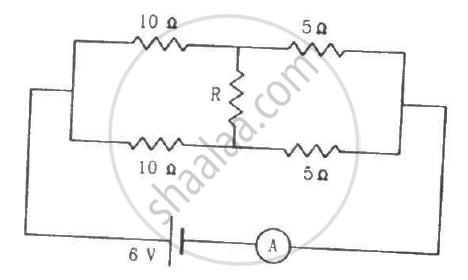
What should be the value of R in the figure for which the current in it is zero?
In Wheatstone’s meter-bridge experiment, the null point is obtained in the middle one-third portion of the wire. Why is it recommended?
Four resistances 4 Ω, 8Ω, XΩ and 12Ω are connected in a series to form Wheatstone’s network. If the network is balanced, the value of X is ______.
In a meter bridge, two unknown resistances R and S, when connected between the two gaps, give a null point is 60 cm from one end. What is the ratio of R and S?
The current which flows in a galvanometer of Wheatstone bridge is directly proportional to ______
In a Wheatstone bridge, when the potentials at points B and D are the same, then the current through the galvanometer ______

In the circuit shown, a metre bridge is in its balanced state. The metre bridge wire has a resistance 0.1 ohm/cm. The value of unknown resistance X and the current drawn from the battery of negligible resistance are ____________.

With a resistance of 'X' in the left gap and a resistance of 9 Ω in the right gap of a meter bridge, the balance point is obtained at 40 cm from the left end.
In what way and to which resistance 3 Ω resistance be connected to obtain the balance at 50 cm from the left end?
In Wheatstone's bridge P = 7 ohm, Q = 12 ohm, R = 3 ohm and S = 8 ohm. How much resistance must be put in parallel to the resistance S to balance the bridge?
ln the metre bridge experiment, one metre long wire acts as ____________.
In the Wheatstone bridge, (shown in the figure) X = Y and A > B. The direction of the current between a and b will be ____________.

In the network shown cell E has internal resistance r and the galvanometer shows zero deflection. If the cell is replaced by a new cell of emf 2E and internal resistance 3r keeping everything else identical, then ______.

Two resistances prepared from the wire of the same material having diameters in the ratio 2 : 1 and lengths in the ratio 2 : 1 are connected in the left gap and right gap of Wheatstone's meter bridge respectively. The distance of the null point from the left end of the wire is ______
In a meter bridge experiment, to minimize an error due to contact resistance, ______
ln, a Wheatstone network, P = Q = R = 8 `Omega` and S is 10 `Omega`. The required resistance to be connected to S so that network is balanced is ______.
A resistance of 20 Ω is connected in the left gap of a meter bridge and an unknown resistance greater than 20 Ω is connected in the right gap. When these resistances are interchanged, the balance point shifts by 20 cm. The unknown resistance is ______.
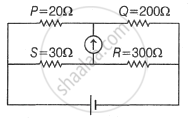
The figure below shows a balanced Wheatstone network. If it is disturbed by changing P to 22Ω, then which of the following steps will bring the bridge again to a balanced state?
Draw a neat labelled diagram to determine unknown resistance using a meter bridge.
What is a post office box? How is the· unknown resistance measured using a post office box?
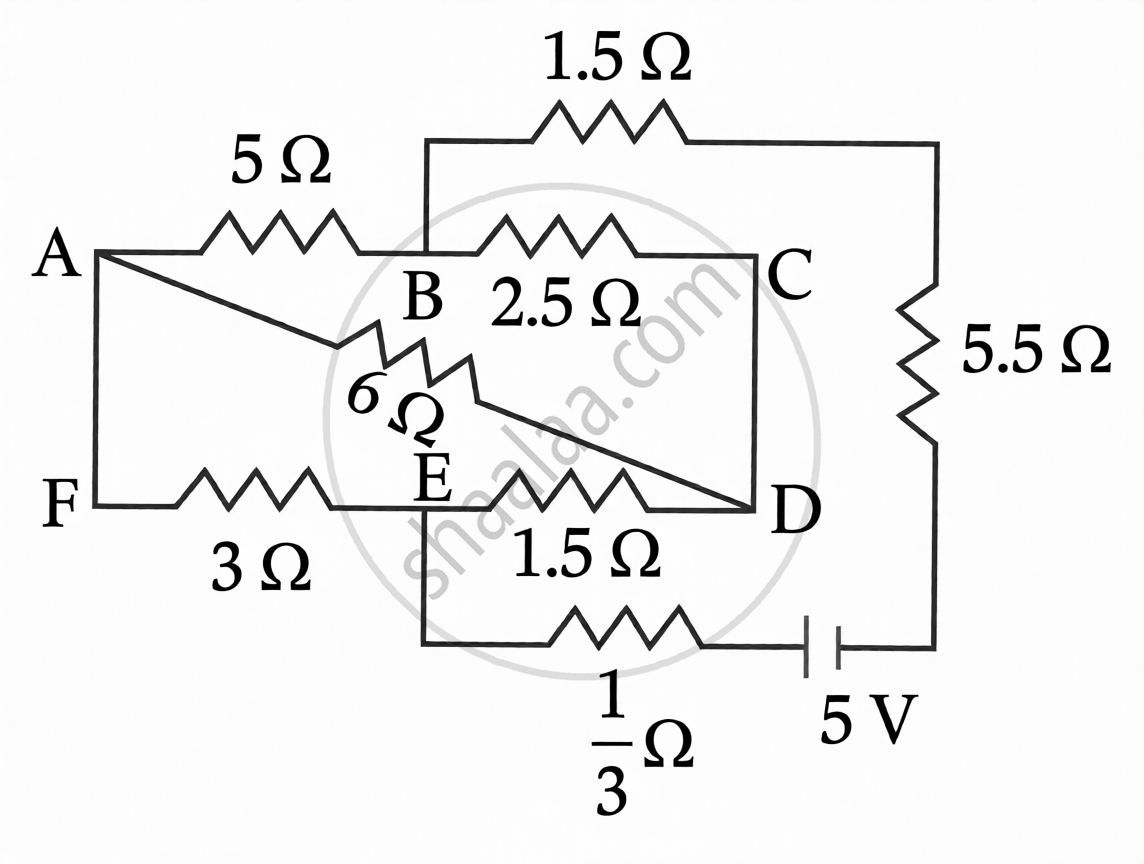
The current passing through the battery in the given circuit is:
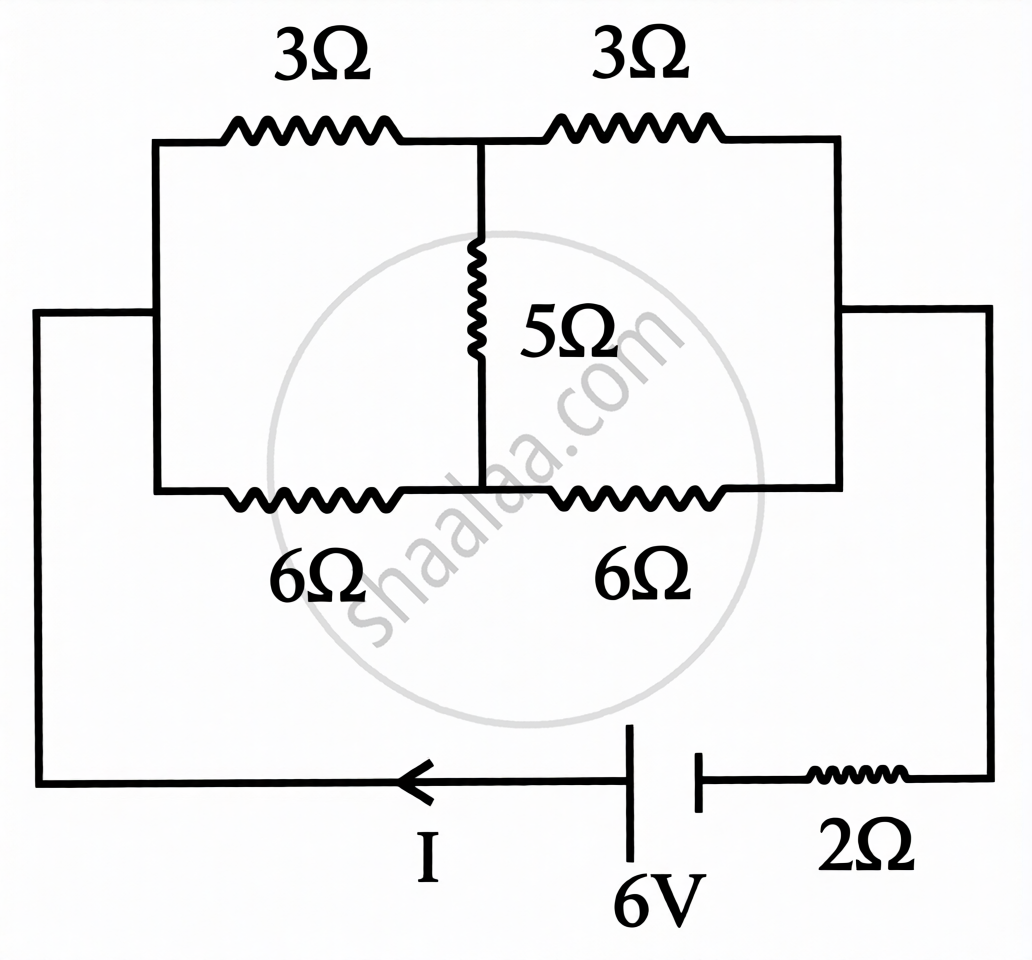
A battery of 6 V is connected to the circuit as shown below. The current I drawn from the battery is:
What is the mathematical expression for the balance condition of a Wheatstone bridge?
Which diagonal in a Wheatstone bridge serves as the galvanometer arm?
What is the main difference between a balanced and an unbalanced Wheatstone bridge in terms of galvanometer deflection?
What is the balance condition used to find the variable resistor Q?
Why is high accuracy achievable in Wheatstone bridge measurements?
