Advertisements
Advertisements
प्रश्न
State and explain the clock-face rule for determining the polarities of a circular wire carrying current.
Advertisements
उत्तर
This rule is used to determine the polarity of two faces of a current-carrying circular coil.
According to the clock-face rule, if we look at one face of the coil through which a current is passing, we have the following conclusions:
- If the current around the face of the coil flows in a clockwise direction, that face of the coil will be the south pole.
- If the current around the face of the coil flows in an anticlockwise direction, that face of the coil will be north pole.
संबंधित प्रश्न
Consider a circular loop of wire lying in the plane of the table. Let the current pass through the loop clockwise. Apply the right-hand rule to find out the direction of the magnetic field inside and outside the loop.
Name the rule for finding the direction of magnetic field produced by a straight current-carrying conductor.
What is the shape of a current-carrying conductor whose magnetic field pattern resembles that of a bar magnet?
State condition when magnitude of force on a current carrying conductor placed in a magnetic field is zero?
A coil ABCD mounted on an axle is placed between the poles N and S of a permanent magnet as shown in Figure.
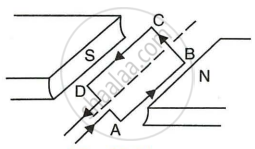
- In which direction will the coil begin to rotate when current is passed through the coil in direction ABCD by connecting a battery at the ends A and D of the coil?
- Why is a commutator necessary for continuous rotation of the coil?
- Complete the diagram with commutator, etc. for the flow of current in the coil?
State whether a magnetic field is associated or not around a moving charge.
A current flows in a wire running between the S and N poles of a magnet lying horizontally as shown in the figure below:

The force on the wire due to the magnet is directed ____________.
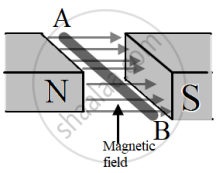
The diagram below shows a free conductor AB is kept in a magnetic field and is carrying current from A to B. (To avoid confusion complete path of the circuit is not shown) The direction of the force experienced by the conductor will be:
A simple motor is made in a school laboratory. A coil of wire is mounted on an axle between the poles of a horseshoe magnet, as illustrated.

In the example above, coil ABCD is horizontal and the battery is connected as shown.
- For this position, state the direction of the force on the arm AB.
- Why does the current in the arm BC not contribute to the turning force on the coil?
|
The graph (fig A) illustrates the correlation between the number of protons (x-axis) and the number of neutrons (y-axis) for elements A, B, C, D, and E in the periodic table. These elements are denoted by the letters rather than their conventional symbols. When the element C, depicted in the graph, undergoes radioactive decay, it releases radioactive rays. When these rays are directed into the plane of the paper in the presence of a magnetic field, as indicated in the fig B, they experience deflection, causing them to move upwards.
|
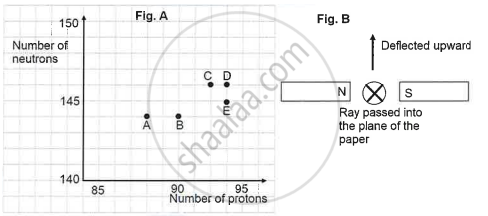
Name the law used to identify the radioactive radiation emitted by the element.
