Advertisements
Advertisements
प्रश्न
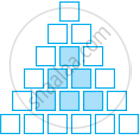
Sonal and Anmol then made another sequence of the designs. Three of the designs are shown below.
 |
 |
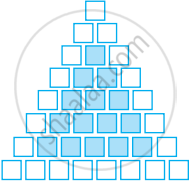 |
(a) Complete the table.
| Rows, r | 4 | 6 | 8 |
| Number of white Tiles, w | 9 | ||
| Number of Purple Tiles, p | 1 |
(b) Draw a graph of rows and number of white tiles. Draw another graph of the number of rows and the number of purple tiles. Put the number of rows on the horizontal axis.
(c) Which graph is linear?
Advertisements
उत्तर
(a) Complete the table.
| Rows, r | 4 | 6 | 8 |
| Number of white Tiles, w | 9 | 15 | 21 |
| Number of Purple Tiles, p | 1 | 6 | 15 |
(b) Graph between rows and number of white titles is shown below
Graph between rows and number of purple titles is shown below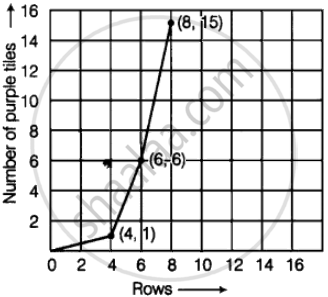
(c) No graph is linear.
APPEARS IN
संबंधित प्रश्न
Decide which of the following statements is true and which is false. Give reasons for your answer.
Points whose x and y coordinates are equal, lie on a line passing through the origin.
The coordinates of a point at a distance of 3 units from the x axis and 6 units from the y axis is ______.
The process of fixing a point with the help of the coordinates is known as ______ of the point.
In the coordinates of a point, the second number denotes the ______.
The point where the two axes intersect is called the ______.
For fixing a point on the graph sheet we need two coordinates.
The y-coordinate of any point lying on the x-axis will be zero.
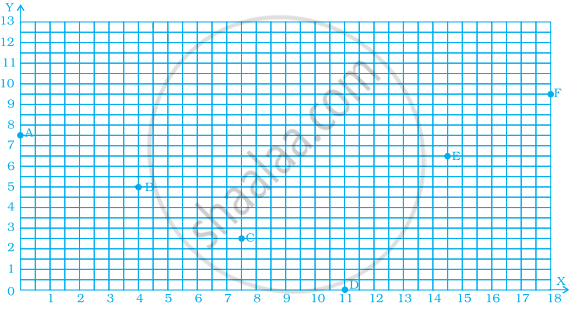
Find the coordinates of all letters in the graph given below.
Write the x-coordinate (abscissa) of the given point.
(5, 7)
Explain the situations represented by the following distance-time graph.

