Advertisements
Advertisements
प्रश्न
Solve the following pair of equations:
x + y = 3.3, `0.6/(3x - 2y) = -1, 3x - 2y ≠ 0`
Advertisements
उत्तर
Given pair of linear equation are
x + y = 3.3 ......(i)
And `0.6/(3x - 2y)` = – 1
⇒ 0.6 = – 3x + 2y
⇒ 3x – 2y = – 0.6 .....(ii)
Now, multiplying equation (i) by 2 and then adding with equation (ii), we get
⇒ 2x + 2y = 6.6
⇒ 3x – 2y = – 0.6
5x = 6
⇒ x =`6/5` = 1.2
Now, put the value of x in equation (i), we get
1.2 + y = 3.3
⇒ y = 3.3 – 1.2
⇒ y = 2.1
Hence, the required values of x and y are 1.2 and 2.1, respectively.
APPEARS IN
संबंधित प्रश्न
Form the pair of linear equations in the following problems and find their solutions (if they exist) by any algebraic method
The area of a rectangle gets reduced by 9 square units, if its length is reduced by 5 units and breadth is increased by 3 units. If we increase the length by 3 units and the breadth by 2 units, the area increases by 67 square units. Find the dimensions of the rectangle.
Solve the following systems of equations:
`1/(7x) + 1/(6y) = 3`
`1/(2x) - 1/(3y) = 5`
Solve the following systems of equations:
`10/(x + y) + 2/(x - y) = 4`
`15/(x + y) - 5/(x - y) = -2`
Solve the following system of equations by the method of cross-multiplication:
3x + 2y + 25 = 0
2x + y + 10 = 0
Solve the following system of equations by the method of cross-multiplication:
ax + by = a – b
bx – ay = a + b
Solve each of the following systems of equations by the method of cross-multiplication
`x/a + y/b = 2`
`ax - by = a^2 - b^2`
Solve each of the following systems of equations by the method of cross-multiplication
`x/a = y/b`
`ax + by = a^2 + b^2`
Solve the following system of equations by the method of cross-multiplication:
`(ax)/b - (by)/a = a + b`
ax – by = 2ab
Solve the system of equations by using the method of cross multiplication:
3x + 2y + 25 = 0, 2x + y + 10 = 0
Solve the system of equations by using the method of cross multiplication:
`a/x - b/y = 0, (ab^2)/x + (a^2b)/y = (a^2 + b^2)`, where x ≠ 0 and y ≠ 0
Complete the activity to find the value of x.
3x + 2y = 11 ...(i) and 2x + 3y = 4 ...(ii)
Solution:
Multiply equation (i) by ______ and equation (ii) by ______.
`square` × (3x + 2y = 11) ∴ 9x + 6y = 33 ...(iii)
`square` × (2x + 3y = 4) ∴ 4x + 6y = 8 ...(iv)
Subtract (iv) from (iii),
`square` x = 25
∴ x = `square`
Find the values of x and y in the following rectangle [see figure].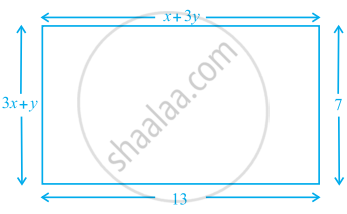
Solve the following pair of equations:
`1/(2x) - 1/y = -1, 1/x + 1/(2y) = 8, x, y ≠ 0`
Solve the following pair of equations:
`x/a + y/b = a + b, x/a^2 + y/b^2 = 2, a, b ≠ 0`
A two-digit number is obtained by either multiplying the sum of the digits by 8 and then subtracting 5 or by multiplying the difference of the digits by 16 and then adding 3. Find the number.
A railway half ticket costs half the full fare, but the reservation charges are the same on a half ticket as on a full ticket. One reserved first class ticket from the station A to B costs Rs 2530. Also, one reserved first class ticket and one reserved first class half ticket from A to B costs Rs 3810. Find the full first class fare from station A to B, and also the reservation charges for a ticket.
Vijay had some bananas, and he divided them into two lots A and B. He sold the first lot at the rate of Rs 2 for 3 bananas and the second lot at the rate of Re 1 per banana, and got a total of Rs 400. If he had sold the first lot at the rate of Re 1 per banana, and the second lot at the rate of Rs 4 for 5 bananas, his total collection would have been Rs 460. Find the total number of bananas he had.
Anuj had some chocolates, and he divided them into two lots A and B. He sold the first lot at the rate of ₹ 2 for 3 chocolates and the second lot at the rate of ₹ 1 per chocolate, and got a total of ₹ 400. If he had sold the first lot at the rate of ₹ 1 per chocolate, and the second lot at the rate of ₹4 for 5 chocolates, his total collection would have been ₹460. Find the total number of chocolates he had.
