Advertisements
Advertisements
प्रश्न
Solve the following minimal assignment problem and hence find minimum time where '- ' indicates that job cannot be assigned to the machine :
| Machines | Processing time in hours | ||||
| A | B | C | D | E | |
| M1 | 9 | 11 | 15 | 10 | 11 |
| M2 | 12 | 9 | - | 10 | 9 |
| M3 | - | 11 | 14 | 11 | 7 |
| M4 | 14 | 8 | 12 | 7 | 8 |
Advertisements
उत्तर
Step 1 : The problem is unbalanced. So, it is balanced by introducing a dummy machine M5 with O.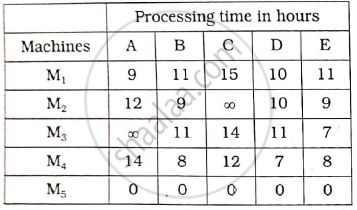
Step 2 : Minimum element of each row is subtracted from every element in that row.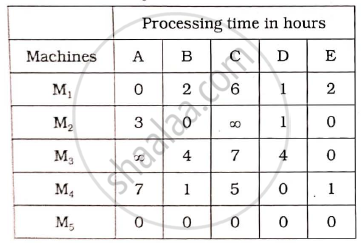
Step 3 : Zero element are covered with minimum number of straight lines :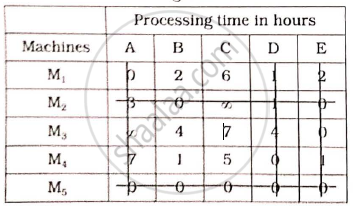
Minimum number of lines = order of matrix = 5
∴ Optimum solution is reached
Step 4 : Making assignment at single zero of the row and then at single zero of the column.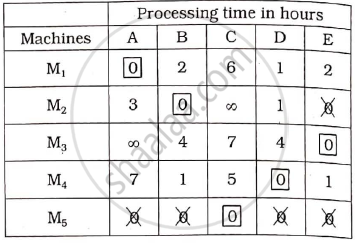
The optional assignment is
M1 → A
M2 → B
M3 → E
M4 → D
M5 → C
∴ Minimum Time= 9 + 9 + 7 + 7 + 0 = 32 hrs.
APPEARS IN
संबंधित प्रश्न
Determine `l_92 and l_93, "given that" l_91 = 97, d_91 = 38 and q_92 = 27/59`
Solve the following maximal assignment problem :
| Branch Manager | Monthly Business ( Rs. lakh) | |||
| A | B | C | D | |
| P | 11 | 11 | 9 | 9 |
| Q | 13 | 16 | 11 | 10 |
| R | 12 | 17 | 13 | 8 |
| S | 16 | 14 | 16 | 12 |
A departmental head has three jobs and four subordinates. The subordinates differ in their capabilities and the jobs differ in their work
contents. With the help of the performance matrix given below, find out which of the four subordinates should be assigned which jobs ?
| Subordinates | Jobs | ||
| I | II | III | |
| A | 7 | 3 | 5 |
| B | 2 | 7 | 4 |
| C | 6 | 5 | 3 |
| D | 3 | 4 | 7 |
Five wagons are available at stations 1, 2, 3, 4, and 5. These are required at 5 stations I, II, III, IV, and V. The mileage between various stations are given in the table below. How should the wagons be transported so as to minimize the mileage covered?
| I | II | III | IV | V | |
| 1 | 10 | 5 | 9 | 18 | 11 |
| 2 | 13 | 9 | 6 | 12 | 14 |
| 3 | 3 | 2 | 4 | 4 | 5 |
| 4 | 18 | 9 | 12 | 17 | 15 |
| 5 | 11 | 6 | 14 | 19 | 10 |
The objective of an assignment problem is to assign ______.
Fill in the blank :
An _______ is a special type of linear programming problem.
In an assignment problem, if number of column is greater than number of rows, then a dummy column is added.
Solve the following problem :
A plant manager has four subordinates, and four tasks to be performed. The subordinates differ in efficiency and the tasks differ in their intrinsic difficulty. This estimate of the time each man would take to perform each task is given in the effectiveness matrix below.
| I | II | III | IV | |
| A | 7 | 25 | 26 | 10 |
| B | 12 | 27 | 3 | 25 |
| C | 37 | 18 | 17 | 14 |
| D | 18 | 25 | 23 | 9 |
How should the tasks be allocated, one to a man, as to minimize the total man hours?
Choose the correct alternative:
Assignment Problem is special case of ______
Choose the correct alternative:
The assignment problem is said to be balanced if ______
State whether the following statement is True or False:
The objective of an assignment problem is to assign number of jobs to equal number of persons at maximum cost
State whether the following statement is True or False:
In assignment problem, if number of columns is greater than number of rows, then a dummy row is added
State whether the following statement is True or False:
In assignment problem each worker or machine is assigned only one job
What is the Assignment problem?
What is the difference between Assignment Problem and Transportation Problem?
Find the optimal solution for the assignment problem with the following cost matrix.
| Area | |||||
| 1 | 2 | 3 | 4 | ||
| P | 11 | 17 | 8 | 16 | |
| Salesman | Q | 9 | 7 | 12 | 6 |
| R | 13 | 16 | 15 | 12 | |
| S | 14 | 10 | 12 | 11 | |
Assign four trucks 1, 2, 3 and 4 to vacant spaces A, B, C, D, E and F so that distance travelled is minimized. The matrix below shows the distance.
| 1 | 2 | 3 | 4 | |
| A | 4 | 7 | 3 | 7 |
| B | 8 | 2 | 5 | 5 |
| C | 4 | 9 | 6 | 9 |
| D | 7 | 5 | 4 | 8 |
| E | 6 | 3 | 5 | 4 |
| F | 6 | 8 | 7 | 3 |
Choose the correct alternative:
If number of sources is not equal to number of destinations, the assignment problem is called ______
Choose the correct alternative:
In an assignment problem involving four workers and three jobs, total number of assignments possible are
A department store has four workers to pack goods. The times (in minutes) required for each worker to complete the packings per item sold is given below. How should the manager of the store assign the jobs to the workers, so as to minimize the total time of packing?
| Workers | Packing of | |||
| Books | Toys | Crockery | Cutlery | |
| A | 3 | 11 | 10 | 8 |
| B | 13 | 2 | 12 | 12 |
| C | 3 | 4 | 6 | 1 |
| D | 4 | 15 | 4 | 9 |
