Advertisements
Advertisements
प्रश्न
Solve the following maximal assignment problem :
| Branch Manager | Monthly Business ( Rs. lakh) | |||
| A | B | C | D | |
| P | 11 | 11 | 9 | 9 |
| Q | 13 | 16 | 11 | 10 |
| R | 12 | 17 | 13 | 8 |
| S | 16 | 14 | 16 | 12 |
Advertisements
उत्तर
| Branch Manager | Monthly Business ( Rs. lakh) | |||
| A | B | C | D | |
| P | 11 | 11 | 9 | 9 |
| Q | 13 | 16 | 11 | 10 |
| R | 12 | 17 | 13 | 8 |
| S | 16 | 14 | 16 | 12 |
Step 1 : Since it is a maximization problem subtract each of the element in the table from the largest element.
| Branch Manager | Monthly Business ( Rs. lakh) | |||
| A | B | C | D | |
| P | 6 | 6 | 8 | 8 |
| Q | 4 | 1 | 6 | 7 |
| R | 5 | 0 | 4 | 9 |
| S | 1 | 3 | 1 | 5 |
Step 2 : Minimum element of each row is subtracted from every element in that row.
| Branch Manager | Monthly Business ( Rs. lakh) | |||
| A | B | C | D | |
| P | 0 | 0 | 2 | 2 |
| Q | 3 | 0 | 5 | 6 |
| R | 5 | 0 | 4 | 9 |
| S | 0 | 2 | 0 | 4 |
Step 3 : Minimum element of each column is subtracted from every element in that column.
| Branch Manager | Monthly Business ( Rs. lakh) | |||
| A | B | C | D | |
| P | 0 | 0 | 2 | 0 |
| Q | 3 | 0 | 5 | 4 |
| R | 5 | 0 | 4 | 7 |
| S | 0 | 2 | 0 | 2 |
Step 4 : Zero elements are covered With minimum number of straight lines.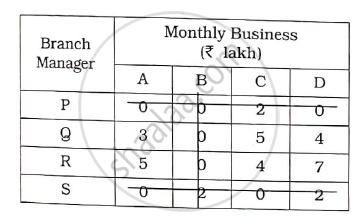
Step 5 : Selecting the smallest element not covered by the lines and subtracting it from each uncovered element and add it to the intersection of the lines.
Step 6 : Covering all zeros by minimum number of straight lines.
Minimum number of lines = order of matrix. so optimal solution has reached.
Step 7 : Making assignment at single zero of the row and then at single zero of the column.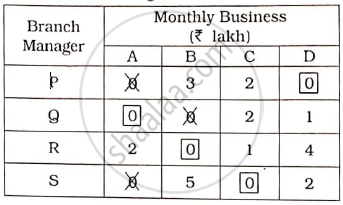
The optimal assignment is
P → D
Q → A
R → B
S → C
Maximum Profit = 9 + 13 + 17 + 16 = 55 lakhs.
APPEARS IN
संबंधित प्रश्न
A job production unit has four jobs A, B, C, D which can be manufactured on each of the four machines P, Q, R and S. The processing cost of each job is given in the following table:
|
Jobs
|
Machines |
|||
|
P |
Q |
R |
S |
|
|
Processing Cost (Rs.)
|
||||
|
A |
31 |
25 |
33 |
29 |
|
B |
25 |
24 |
23 |
21 |
|
C |
19 |
21 |
23 |
24 |
|
D |
38 |
36 |
34 |
40 |
How should the jobs be assigned to the four machines so that the total processing cost is minimum?
Suggest optimum solution to the following assignment. Problem, also find the total minimum service time.
Service Time ( in hrs.)
| Counters | Salesmen | |||
| A | B | C | D | |
| W | 41 | 72 | 39 | 52 |
| X | 22 | 29 | 49 | 65 |
| Y | 27 | 39 | 60 | 51 |
| Z | 45 | 50 | 48 | 52 |
Determine `l_92 and l_93, "given that" l_91 = 97, d_91 = 38 and q_92 = 27/59`
Fill in the blank :
An _______ is a special type of linear programming problem.
If the given matrix is ______ matrix, the assignment problem is called balanced problem
In an assignment problem if number of rows is greater than number of columns, then dummy ______ is added
State whether the following statement is True or False:
The objective of an assignment problem is to assign number of jobs to equal number of persons at maximum cost
State whether the following statement is True or False:
In assignment problem each worker or machine is assigned only one job
Give mathematical form of Assignment problem
What is the difference between Assignment Problem and Transportation Problem?
Assign four trucks 1, 2, 3 and 4 to vacant spaces A, B, C, D, E and F so that distance travelled is minimized. The matrix below shows the distance.
| 1 | 2 | 3 | 4 | |
| A | 4 | 7 | 3 | 7 |
| B | 8 | 2 | 5 | 5 |
| C | 4 | 9 | 6 | 9 |
| D | 7 | 5 | 4 | 8 |
| E | 6 | 3 | 5 | 4 |
| F | 6 | 8 | 7 | 3 |
Choose the correct alternative:
North – West Corner refers to ______
Choose the correct alternative:
If number of sources is not equal to number of destinations, the assignment problem is called ______
Choose the correct alternative:
The purpose of a dummy row or column in an assignment problem is to
Choose the correct alternative:
The solution for an assignment problem is optimal if
A car hire company has one car at each of five depots a, b, c, d and e. A customer in each of the fine towers A, B, C, D and E requires a car. The distance (in miles) between the depots (origins) and the towers(destinations) where the customers are given in the following distance matrix.
| a | b | c | d | e | |
| A | 160 | 130 | 175 | 190 | 200 |
| B | 135 | 120 | 130 | 160 | 175 |
| C | 140 | 110 | 155 | 170 | 185 |
| D | 50 | 50 | 80 | 80 | 110 |
| E | 55 | 35 | 70 | 80 | 105 |
How should the cars be assigned to the customers so as to minimize the distance travelled?
A natural truck-rental service has a surplus of one truck in each of the cities 1, 2, 3, 4, 5 and 6 and a deficit of one truck in each of the cities 7, 8, 9, 10, 11 and 12. The distance(in kilometers) between the cities with a surplus and the cities with a deficit are displayed below:
| To | |||||||
| 7 | 8 | 9 | 10 | 11 | 12 | ||
| From | 1 | 31 | 62 | 29 | 42 | 15 | 41 |
| 2 | 12 | 19 | 39 | 55 | 71 | 40 | |
| 3 | 17 | 29 | 50 | 41 | 22 | 22 | |
| 4 | 35 | 40 | 38 | 42 | 27 | 33 | |
| 5 | 19 | 30 | 29 | 16 | 20 | 33 | |
| 6 | 72 | 30 | 30 | 50 | 41 | 20 | |
How should the truck be dispersed so as to minimize the total distance travelled?
A job production unit has four jobs P, Q, R, and S which can be manufactured on each of the four machines I, II, III, and IV. The processing cost of each job for each machine is given in the following table:
| Job | Machines (Processing cost in ₹) |
|||
| I | II | III | IV | |
| P | 31 | 25 | 33 | 29 |
| Q | 25 | 24 | 23 | 21 |
| R | 19 | 21 | 23 | 24 |
| S | 38 | 36 | 34 | 40 |
Find the optimal assignment to minimize the total processing cost.
A department store has four workers to pack goods. The times (in minutes) required for each worker to complete the packings per item sold is given below. How should the manager of the store assign the jobs to the workers, so as to minimize the total time of packing?
| Workers | Packing of | |||
| Books | Toys | Crockery | Cutlery | |
| A | 3 | 11 | 10 | 8 |
| B | 13 | 2 | 12 | 12 |
| C | 3 | 4 | 6 | 1 |
| D | 4 | 15 | 4 | 9 |
