Advertisements
Advertisements
प्रश्न
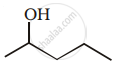
Show how you would synthesise the following alcohol from an appropriate alkene?
Advertisements
उत्तर
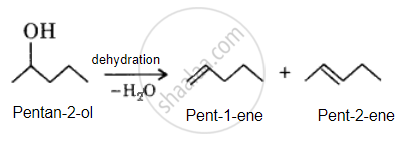
By adding H2O to pent-1-ene, the desired alcohol is obtained.


Hence, the desired alkene will be pent-1-ene instead of pent-2-ene.
APPEARS IN
संबंधित प्रश्न
Name the reagents used in the following reactions:

Write the structures of the main products when acetone (CH3 − CO − CH3) reacts with the following reagents :
CH3MgBr and then H3O+
Predict the major product of acid catalysed dehydration of butan-1-ol.
Write the mechanism of hydration of ethene to yield ethanol.
How is the following conversion carried out?
\[\ce{Methyl magnesium bromide → 2-Methylpropan-2-ol}\]
Name the reagent used in the following reaction:
Butan-2-one to butan-2-ol.

Show how you would synthesise the following alcohol from an appropriate alkene?

Ketones react with Grignard reagent to produce ____________.
Aldehydes are reduced to the corresponding alcohols by the addition of hydrogen in the presence of catalysts to form ____________.
Benzaldehyde differs from acetaldehyde in that:
Acetone reacts with Grignard reagent to form:
Identify ‘C’ in the following:

Why is the reactivity of all the three classes of alcohols with conc. \[\ce{HCl}\] and \[\ce{ZnCl2}\] (Lucas reagent) different?
Alkaline hydrolysis of an alkyl halide can be preferably carried out using ______.
The major product of acid catalysed dehydration of 1-methylcyclohexanol is ______.


The products "A" and "B" formed in above reactions are:
\[\ce{? ->[\Delta, CN-][EtOH, H2O]}\] Benzoin.
The reactant is obtained by dry distillation of the calcium salts of the following pairs:
The major product of the following reaction is:
\[\begin{array}{cc}
\ce{Cl}\phantom{.........................}\\
|\phantom{..........................}\\
\ce{CH3 - CH - CH3 ->[(i) Alc. KOH][(ii) HBr/peroxide (iii) aq. KOH]}
\end{array}\]
