Advertisements
Advertisements
प्रश्न
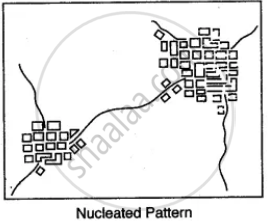
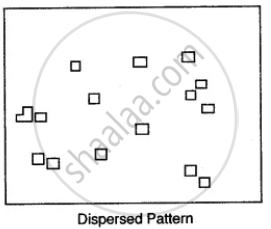
Name the various types of settlement patterns found on toposheet.
Advertisements
उत्तर

संबंधित प्रश्न
Name the following: An offshore oil field in the Gulf of Cambay.
What is the compass direction of Dantrai from Jolpur?
Name the left bank tributary of the main river.
Calculate the distance in kilometres along the cart track between Chitrasani (999747) and Pirojpura (978753).
Why are directions on a map important?
The area is measured by grid square method?
What is a Nodal centre?
(i) What is the importance of a Relief Map.
(ii) How can we show occupations by the evidences of names or by inference of relief features?
Answer the following questions on the Survey Sheet Number 45 D/10. Eastings 00 to 10; Northings 17 to 28. (Map G)
(a) Give four-figure grid references of the following:
(i) Dhad Talao (ii) Sheet rock in the North-east
(iii) Rock outcrop in the North (iv) Stony waste in the South-east
(v) Open scrub south of Dhad Talao
(b) Give the six-figure grid references of the following:
(i) Police Chowki in village Dantral
(ii) Temple in Bhamra village
(iii) Well with water in settlement Devka
(iv) Spot height 310 near village Jolpur
(v) Tank near Indaria settlement
(c) Give-the direction of the following:
(i) Village Dantral (0324) from Dhann (0723)
(ii) Village Bhamra (0521) from Dhann (0723)
(iii) Village Jolpur (0718) from Malawa (0519)
(iv) Village Warka (0716) from Bikanwas (0316)
(v) Village Rampura (0617) from Dhann (0723)
(d) Give the meanings of the following:
(i) 15r in blue in grid square 0224.
(ii) 300 in brown in grid square 0426.
(iii) Black line in the northernmost part of the map.
(iv) Red line in grid square 0819.
(v) Black dots in grid square 0617.
(e) Give the settlement patterns of the following:
(i) Village Dhann (ii) In grid square 0220
(f) Measure the distances of the following:
(i) Direct distance in km. from Indaria (0826) to Jolpur (0718)
(ii) Indirect distance in km. along the cart track from Dantral (0324) to Dhann (0723)
(g) Give the drainage patterns of the following:
(i) 0827 (ii) In grid square 0226
(h) Name three man-made features found in grid square 0419 and draw their symbols.
(i) Give two evidences that the region gets seasonal rainfall.
(j) Explain the nature of the river.
(k) Explain the relief of the area.
(l) What is the general slope of the land? Give reason for your answer.
(m) What is the main occupation of the people? Give reason for your answer.
(n) What is the mode of irrigation? Give reasons for your answer.
(o) What is the mode of transport? Give reasons for your answer.
Study the extract of the Survey of India Map Sheet No. 45 D/7 (A – B) and answer the following questions:
(a) (i) What does the abbreviation R. F., stand for?
(ii) What does 20r (grid sq. 8295) mean.
(iii) What does V near Shergadh village in the south-east corner mean.
(b)
(i) What type of relief do you observe in north-west of the map (West Panswala)?
(ii) Why is the land shown in white shade not put to cultivation?
(c)
(i) What seems to be the importance of village Jegol in grid sq. 8590 in the south?
(ii) Find out the length of the joint stream of rivers Sipu, Varka and Hanva.
(d) What type of relief feature is found close to Varkanala and Hanvanala near Gangudra in the centre of the area?
(e) Give four figure grid reference of a well marked meander of Varkanala and Sipu river.
(f)
(i) What does the black line marked 24°30′ in the north denote.
(ii) What is the meaning of 72°20′ north-south black line in the western part of the map?
(iii) What do the figures 280, 300, 500 etc., written in brown on east margin of the map indicate.
(g)
(i) Point out two man-made features on the map.
(ii) What is the direction of the river Sipu 83 C 86 grid lines?
(iii) What is the grid reference (four figures) of the lime kiln located near Rampura village in the north-west?
