Advertisements
Advertisements
प्रश्न
"My right to swing my fist ends, where your nose begins." Elucidate with reference to, ‘On the Rule of the Road’.
Advertisements
उत्तर
Rights are not completely individual affairs. In order to enjoy one’s rights, one has to respect the rights of others too. The lady in Petrograd had the right to walk on the pavement. The right to move stops when the other person’s right to drive starts. A person may have a walking stick and roll it too. But his right just stops where the other person’s nose begins. No one has the right to violate the rights of others. The right, one exercise, must not affect or erode the rights of others. One should not think of one’s own rights but also the rights of others.
A.G.Gardiner beautifully illustrates this idea by emphasizing the metaphor of traffic rules. Rules of the road are in fact rules of politeness and unselfishness. One may have absolute freedom in the choice, of food, religion, fashionable dress, upkeep of hair, funny hairstyle, etc. But one must be conscious of the rights of others. So, the statement “my right to swing my fist ends, where your nose begins” fits well with the central theme of the essay ‘ On the Rule of the Road’.
APPEARS IN
संबंधित प्रश्न
Why did the driver not approve of the narrator buying fruits from the boys?
What was Lucia suffering from?
Describe the appearance of Nicola and Jacopo.
What were the various jobs undertaken by the little boys?
Why does the author say that it is important to include a tea recipe in cookery books?
Which tea does the author prefer– China tea or Indian tea?
Whom does the author call ‘misguided people’? What is his advice to them?
What are the author’s views on China tea?
How was Dr. Barnard’s attitude to suffering different from that of his father’s?
What roles did the duo take up?
Who encouraged them and how?
What was the profound lesson that Dr. Barnard learnt from the boys?
Name an equipment and a tool carried by the climbers during their expedition.
What did Hillary mean by saying “We had had enough to do the job, but by no means too much”?
What was put on the family agenda?
Who visited the family?
Why did the family find it difficult to make a chair?
Write character sketches of Maamanaar and Pedanna.
From the pictures given below, identity the actions that may cause inconvenience and discomfort to others. Discuss.
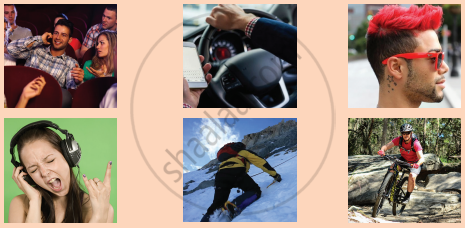
Classify these pictures to show what they depict–Personal freedom/Public liberty.
| Personal freedom | Public liberty |
| colouring the hair red | |
Why did the lady think she was entitled to walk down the middle of the road?
Define ‘liberty’ as perceived by the author.
Why is there a danger of the world getting ‘liberty drunk’?
Para 4
Tenzing kicked steps in a long
traverse back towards the ridge, and we
reached its crest where it forms a great
snow bump at about 28000 feet. From
here the ridge narrowed to a knife-edge
and, as my feet were now warm, I took
over the lead.
Para 5
The soft snow made a route on top
of the ridge both difficult and dangerous,
which sometimes held my weight but often
gave way suddenly. After several hundred
feet, we came to a tiny hollow and found
there the two oxygen bottles left on the
an earlier attempt by Evans and Bourdillon.
I scraped the ice off the gauges and was
relieved to find that they still contained
several hundred liters of oxygen-enough
to get us down to the South Col if used sparingly
Para 6
I continued making the trail on up
the ridge, leading up for the last 400 feet
to the southern summit. The snow on this
the face was dangerous, but we persisted in
our efforts to beat a trail up it.
We made frequent changes of
lead. As I was stamping a trail in the deep
snow, a section around me gave way and
Para 7
I slipped back through three or four of
my steps. I discussed with Tenzing the
the advisability of going on, and he, although
admitting that he felt unhappy about the
snow conditions, and finished with his
the familiar phrase “Just as you wish”.
Para 8
I decided to go on, and we finally
reached firmer snow higher up, and then
chipped steps up the last steep slopes and
crampon onto the South Peak. It was now 9 a.m.
Give an account of the journey to the South Col from 28,000 feet. (Para 4 to 8)
Para 15
For a few moments, I lay regaining
my breath, and for the first time really
felt the fierce determination that nothing
now could stop us from reaching the top. I took
a firm stance on the ledge and signaled
to Tenzing to come on up. As I heaved
hard on the rope, Tenzing wriggled his
way up the crack, and finally collapsed at
the top like a giant fish when it has just
been hauled from the sea after a terrible
struggle.
Para 16
The ridge continued as before:
giant cornices on the right; steep rock
sloped on the left. The ridge curved away
to the right and we have no idea where the
top was. As I cut around the back of one
hump, another higher one would swing
into view. Time was passing and the ridge
seemed never-ending.
Para 17
Our original zest had now quite
gone, and it was turning more into a grim
struggle. I then realized that the ridge
ahead, instead of rising, now dropped
sharply away. I looked upwards to see a
narrow snow ridge running up to a snowy
summit. A few more whacks of the ice-ax
in the firm snow and we stood on top.
The ridge had taken us two and half hours, but it seemed like lifetime. Why? (Para 15 to 17)
Can you iron your clothes and arrange them? Can you replace a tube light?
Solve the clues given below and complete the cross word

| Across | Down |
| 1.You can watch programmes, matches and news on it | 1. You can sit around it |
| 4. You can lie on this and sleep | 2. You can put flowers in this |
| 6.You can sit on this and relax by yourself | 3. You can sit on this with two other people comfortably |
| 11.You can store all your books here | 5. You can do your writing work on this |
| 12.This can give you light when it is dark | 7. This can cover a small space and decorate the floor |
|
8. You can put all your clothes in here
|
|
|
9. You can look into this to see yourself |
|
|
10. You can sit on this, it has 3 legs. |
