Advertisements
Advertisements
प्रश्न
Let R = [(x, y) : x, y ∈ Z, y = 2x − 4]. If (a, -2) and (4, b2) ∈ R, then write the values of a and b.
Advertisements
उत्तर
R = [(x, y) : x, y ∈ Z, y = 2x − 4]
(a, -2) and (4, b2) ∈ R
\[So, - 2 = 2(a) -4 \]
\[ \Rightarrow 2 = 2a \]
\[ \Rightarrow a = 1\]
\[Also, b^2 = 2\left( 4 \right) - 4\]
\[ \Rightarrow b^2 = 4\]
\[ \Rightarrow b = \pm 2\]
Thus, a =1 and b =\[\pm 2 \]
APPEARS IN
संबंधित प्रश्न
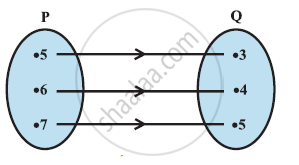
The given figure shows a relationship between the sets P and Q. Write this relation
- in set-builder form.
- in roster form.
What is its domain and range?
Determine the domain and range of the relation R defined by R = {(x, x + 5): x ∈ {0, 1, 2, 3, 4, 5}}.
Let R be the relation on Z defined by R = {(a, b): a, b ∈ Z, a – b is an integer}. Find the domain and range of R.
Find the inverse relation R−1 in each of the cases:
(ii) R = {(x, y), : x, y ∈ N, x + 2y = 8}
Let A = (3, 5) and B = (7, 11). Let R = {(a, b) : a ∈ A, b ∈ B, a − b is odd}. Show that R is an empty relation from A into B.
Determine the domain and range of the relation R defined by
(i) R = [(x, x + 5): x ∈ (0, 1, 2, 3, 4, 5)]
Define a relation R on the set N of natural number by R = {(x, y) : y = x + 5, x is a natural number less than 4, x, y ∈ N}. Depict this relationship using (i) roster form (ii) an arrow diagram. Write down the domain and range or R.
For the relation R1 defined on R by the rule (a, b) ∈ R1 ⇔ 1 + ab > 0. Prove that: (a, b) ∈ R1 and (b , c) ∈ R1 ⇒ (a, c) ∈ R1 is not true for all a, b, c ∈ R.
If R = {(x, y) : x, y ∈ Z, x2 + y2 ≤ 4} is a relation defined on the set Z of integers, then write domain of R.
If A = [1, 3, 5] and B = [2, 4], list of elements of R, if
R = {(x, y) : x, y ∈ A × B and x > y}
Let A = [1, 2, 3, 5], B = [4, 6, 9] and R be a relation from A to B defined by R = {(x, y) : x − yis odd}. Write R in roster form.
If R is a relation from a finite set A having m elements of a finite set B having n elements, then the number of relations from A to B is
If A = {a, b, c}, B = {x, y}, find A × B, B × A, A × A, B × B
If P = {1, 2, 3) and Q = {1, 4}, find sets P × Q and Q × P
Write the relation in the Roster Form. State its domain and range
R3 = {(x, y)/y = 3x, y∈ {3, 6, 9, 12}, x∈ {1, 2, 3}
Write the relation in the Roster Form. State its domain and range
R5 = {(x, y)/x + y = 3, x, y∈ {0, 1, 2, 3}
Answer the following:
Determine the domain and range of the following relation.
R = {(a, b)/b = |a – 1|, a ∈ Z, IaI < 3}
Answer the following:
Find R : A → A when A = {1, 2, 3, 4} such that R = (a, b)/a − b = 10}
Answer the following:
R = {1, 2, 3} → {1, 2, 3} given by R = {(1, 1), (2, 2), (3, 3), (1, 2), (2, 3)} Check if R is symmentric
Answer the following:
Show that the following is an equivalence relation
R in A = {x ∈ Z | 0 ≤ x ≤ 12} given by R = {(a, b)/|a − b| is a multiple of 4}
Let A = {1, 2, 3, 7} and B = {3, 0, –1, 7}, the following is relation from A to B?
R4 = {(7, –1), (0, 3), (3, 3), (0, 7)}
Multiple Choice Question :
Let n(A) = m and n(B) = n then the total number of non-empty relation that can be defined from A to B is ________.
On the set of natural numbers let R be the relation defined by aRb if 2a + 3b = 30. Write down the relation by listing all the pairs. Check whether it is equivalence
Prove that the relation “friendship” is not an equivalence relation on the set of all people in Chennai
On the set of natural numbers let R be the relation defined by aRb if a + b ≤ 6. Write down the relation by listing all the pairs. Check whether it is equivalence
Choose the correct alternative:
Let R be the set of all real numbers. Consider the following subsets of the plane R × R: S = {(x, y) : y = x + 1 and 0 < x < 2} and T = {(x, y) : x − y is an integer} Then which of the following is true?
Choose the correct alternative:
Let X = {1, 2, 3, 4} and R = {(1, 1), (1, 2), (1, 3), (2, 2), (3, 3), (2, 1), (3, 1), (1, 4), (4, 1)}. Then R is
Choose the correct alternative:
Let f : R → R be defined by f(x) = 1 − |x|. Then the range of f is
Is the given relation a function? Give reasons for your answer.
g = `"n", 1/"n" |"n"` is a positive integer
Is the given relation a function? Give reasons for your answer.
s = {(n, n2) | n is a positive integer}
Which statement defines a relation from set \(A\) to set \(B\)?
Which statement violates the condition for a function?
In the ordered pair \((a,b)\), what are \(a\) and \(b\), respectively?
For a relation \(R\), the range is the set of all:
For \(A=\{-1,0,1\}\), which ordered pair is a remaining element of \(A\times A\) besides \((-1,0)\) and \((0,1)\)?
Let \(A=\{1,2,3,4,5\}\), \(B=\{1,4,5\}\), and \((x,y)\in R\) imply \(x
Let \(A=\{1,2,3\}\), \(B=\{3,4\}\), and \(C=\{4,5,6\}\). What is \(A\times(B\cap C)\)?
