Advertisements
Advertisements
प्रश्न
Answer the following:
Show that the following is an equivalence relation
R in A = {x ∈ N/x ≤ 10} given by R = {(a, b)/a = b}
Advertisements
उत्तर
a. Since, a = a
∴ (a, a) ∈ R
∴ R is reflexive.
b. Let (a, b) ∈ R
Then a = b
∴ b = a
∴ (b, a) ∈ R
∴ R is symmetric.
c. Let (a, b), (b, c) ∈ R
Then, a = b, b = c
∴ a = c
∴ (a, c) ∈ R
∴ R is transitive.
Thus, R is an equivalence relation.
APPEARS IN
संबंधित प्रश्न
A = {1, 2, 3, 5} and B = {4, 6, 9}. Define a relation R from A to B by R = {(x, y): the difference between x and y is odd; x ∈ A, y ∈ B}. Write R in roster form.
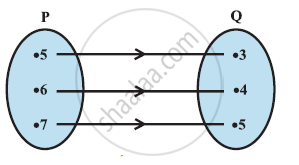
The given figure shows a relationship between the sets P and Q. Write this relation
- in set-builder form.
- in roster form.
What is its domain and range?
Let R be the relation on Z defined by R = {(a, b): a, b ∈ Z, a – b is an integer}. Find the domain and range of R.
Find the inverse relation R−1 in each of the cases:
(iii) R is a relation from {11, 12, 13} to (8, 10, 12] defined by y = x − 3.
Determine the domain and range of the relations:
(i) R = {(a, b) : a ∈ N, a < 5, b = 4}
Let A = {a, b}. List all relations on A and find their number.
Let R be a relation from N to N defined by R = {(a, b) : a, b ∈ N and a = b2}. Is the statement true?
(a, b) ∈ R and (b, c) ∈ R implies (a, c) ∈ R
Justify your answer in case.
Let A = [1, 2, 3, ......., 14]. Define a relation on a set A by
R = {(x, y) : 3x − y = 0, where x, y ∈ A}.
Depict this relationship using an arrow diagram. Write down its domain, co-domain and range.
Let R be a relation on N × N defined by
(a, b) R (c, d) ⇔ a + d = b + c for all (a, b), (c, d) ∈ N × N
(iii) (a, b) R (c, d) and (c, d) R (e, f) ⇒ (a, b) R (e, f) for all (a, b), (c, d), (e, f) ∈ N × N
If R is a relation from set A = (11, 12, 13) to set B = (8, 10, 12) defined by y = x − 3, then write R−1.
Let A = [1, 2, 3, 5], B = [4, 6, 9] and R be a relation from A to B defined by R = {(x, y) : x − yis odd}. Write R in roster form.
If A = {1, 2, 4}, B = {2, 4, 5}, C = {2, 5}, then (A − B) × (B − C) is
Let A = [1, 2, 3], B = [1, 3, 5]. If relation R from A to B is given by = {(1, 3), (2, 5), (3, 3)}, Then R−1 is
If A = [1, 2, 3], B = [1, 4, 6, 9] and R is a relation from A to B defined by 'x' is greater than y. The range of R is
If R = {(x, y) : x, y ∈ Z, x2 + y2 ≤ 4} is a relation on Z, then the domain of R is ______.
Write the relation in the Roster Form. State its domain and range
R3 = {(x, y)/y = 3x, y∈ {3, 6, 9, 12}, x∈ {1, 2, 3}
Answer the following:
If A = {1, 2, 3}, B = {4, 5, 6} check if the following are relations from A to B. Also write its domain and range
R4 = {(4, 2), (2, 6), (5, 1), (2, 4)}
Answer the following:
Determine the domain and range of the following relation.
R = {(a, b)/a ∈ N, a < 5, b = 4}
Answer the following:
Check if R : Z → Z, R = {(a, b)/2 divides a – b} is equivalence relation.
Let A = {1, 2, 3, 7} and B = {3, 0, –1, 7}, the following is relation from A to B?
R2 = {(–1, 1)}
Represent the given relation by
(a) an arrow diagram
(b) a graph and
(c) a set in roster form, wherever possible
{(x, y) | x = 2y, x ∈ {2, 3, 4, 5}, y ∈ {1, 2, 3, 4}
Multiple Choice Question :
Let n(A) = m and n(B) = n then the total number of non-empty relation that can be defined from A to B is ________.
Discuss the following relation for reflexivity, symmetricity and transitivity:
Let P denote the set of all straight lines in a plane. The relation R defined by “lRm if l is perpendicular to m”
Discuss the following relation for reflexivity, symmetricity and transitivity:
Let A be the set consisting of all the members of a family. The relation R defined by “aRb if a is not a sister of b”
Let X = {a, b, c, d} and R = {(a, a), (b, b), (a, c)}. Write down the minimum number of ordered pairs to be included to R to make it equivalence
Let P be the set of all triangles in a plane and R be the relation defined on P as aRb if a is similar to b. Prove that R is an equivalence relation
On the set of natural numbers let R be the relation defined by aRb if a + b ≤ 6. Write down the relation by listing all the pairs. Check whether it is transitive
Choose the correct alternative:
Let X = {1, 2, 3, 4} and R = {(1, 1), (1, 2), (1, 3), (2, 2), (3, 3), (2, 1), (3, 1), (1, 4), (4, 1)}. Then R is
Is the following relation a function? Justify your answer
R1 = `{(2, 3), (1/2, 0), (2, 7), (-4, 6)}`
Is the given relation a function? Give reasons for your answer.
h = {(4, 6), (3, 9), (– 11, 6), (3, 11)}
Which statement defines a relation from set \(A\) to set \(B\)?
A function from set \(A\) to set \(B\) is a relation in which:
When are two ordered pairs \((a,b)\) and \((c,d)\) equal?
For two non-empty sets \(A\) and \(B\), which expression gives their Cartesian product?
For a relation \(R\), the domain is the set of all:
Find \(x\) and \(y\) if \((x+3,2)=(4,y-3)\).
For \(R=\{(1,4),(1,5),(2,4),(2,5),(3,4),(3,5),(4,5)\}\) from \(A\) to \(B=\{1,4,5\}\), which statement is correct?
Let \(A=\{1,2,3\}\), \(B=\{3,4\}\), and \(C=\{4,5,6\}\). What is \((A\times B)\cap(A\times C)\)?
