Advertisements
Advertisements
प्रश्न
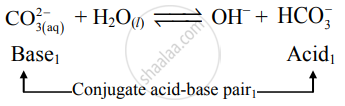
Label the one conjugate acid-base pair in the following reaction.
\[\ce{CO^{2-}_{3(aq)} + H2O_{(l)} ⇌ OH^- + HCO^-_3}\]
Advertisements
उत्तर
APPEARS IN
संबंधित प्रश्न
Choose the most correct answer :
The conjugate base of [Zn(H2O)4]2⊕ is __________.
Answer the following in one sentence :
Why cations are Lewis acids?
Answer the following in brief :
What are acids and bases according to Arrhenius theory?
Answer the following in brief :
What is meant by conjugate acid-base pair?
Label the conjugate acid-base pair in the following reaction:
\[\ce{HCl + H2O ⇌ H3O\overset{\oplus} + Cl\overset{\ominus}{}}\]
Label the conjugate acid-base pair in the following reaction:
\[\ce{CO^2-_3 + H2O ⇌ OH- + HCO^-_3}\]
Answer the following in brief :
Write a reaction in which water acts as a base.
Answer the following in brief :
Ammonia serves as a Lewis base whereas AlCl3 is Lewis acid. Explain.
The theory which explain amphoteric nature of water is ______.
Classify the following species into Lewis acids and Lewis bases.
| Cl- | |
| `"NH"_4^+` | |
| BCl3 | |
| NH3 |
The conjugate acid of \[\ce{HSO^-_4}\] is ____________.
Identify the CORRECT statement.
According to the Bronsted-Lowry theory, an acid is a substance that ____________.
Which of the following fluro compounds is most likely to behave as a Lewis base?
What are Lewis acids and bases? Give two examples for each.
Identify the conjugate acid-base pair for the following reaction in an aqueous solution.
\[\ce{HPO^{2-}_4 + SO^{2-}_3 ⇌ PO^{3-}_4 + HSO^-_3}\]
When aqueous ammonia is added to CuSO4 solution, the solution turns deep blue due to the formation of tetramminecopper (II) complex, \[\ce{[Cu(H2O)6]^{2+}_{( aq)} + 4NH3_{( aq)} ⇌ [Cu(NH3)4]^{2+}_{( aq)}}\], among HO2 and NH3 Which is stronger Lewis base.
Identify the conjugate acid - base pair in the following reaction.
\[\ce{H2O + HCl -> H3O+ + Cl-}\]
Which of the following species is amphoteric in nature?
Define conjugate acid-base pair.
What are the limitations of Arrhenium theory?
According to Lowry-Bronsted concept, base is a substance which acts as ______.
Calculate pH of 0.01 M NaOH.
