Advertisements
Advertisements
प्रश्न
Is it always necessary to use red light to get a photoelectric effect?
Advertisements
उत्तर
No, the broad wavelength and low energy of red light, photons do not have sufficient energy to pull an electron out of its orbital.
APPEARS IN
संबंधित प्रश्न
Using the values of work function given in the following table, tell which metal will require the highest frequency of incident radiation to generate photocurrent.
Typical values of work function for some common metals
| Metal | Work function (in eV) |
| Potassium | 2.3 |
| Sodium | 2.4 |
| Calcium | 2.9 |
| Zinc | 3.6 |
| Silver | 4.3 |
| Aluminium | 4.3 |
| Tungsten | 4.5 |
| Copper | 4.7 |
| Nickel | 5.0 |
| Gold | 5.1 |
Photocurrent recorded in the microammeter in an experimental setup of the photoelectric effect vanishes when the retarding potential is more than 0.8 V if the wavelength of incident radiation is 4950 Å. If the source of incident radiation is changed, the stopping potential turns out to be 1.2 V. Find the work function of the cathode material and the wavelength of the second source.
The threshold wavelength of tungsten is 2.76 x 10⁻⁵ cm.
(a) Explain why no photoelectrons are emitted when the wavelength is more than 2.76 x 10⁻⁵ cm.
(b) What will be the maximum kinetic energy of electrons ejected in each of the following cases
(i) if ultraviolet radiation of wavelength λ = 1.80 × 10⁻⁵ cm and
(ii) radiation of frequency 4 x 10¹⁵ Hz is made incident on the tungsten surface?
Radiation of wavelength 4500 Å is incident on a metal having work function 2.0 eV. Due to the presence of a magnetic field B, the most energetic photoelectrons emitted in a direction perpendicular to the field move along a circular path of radius 20 cm. What is the value of the magnetic field B?
As the intensity of incident light increases ______
The minimum frequency for photoelectric effect on metal is 7 × 10¹⁴ Hz, Find the work function of the metal.
Find the energy of photon which have momentum 2 × 10-16 gm-cm/sec.
If the total energy of radiation of frequency 1014 Hz is 6.63 J, Calculate the number of photons in the radiation.
State Einstein photoelectric equation.
The energy of a photon is 2 eV. Find its frequency and wavelength.
The work function of a surface is 3.1 eV. A photon of frequency 1 × 10¹⁵ Hz. Is an incident on it. Calculate the incident wavelength is photoelectric emission occurs or not.
The maximum velocity of the photoelectron emitted by the metal surface is v. Charge and the mass of the photoelectron is denoted by e and m, respectively. The stopping potential in volt is ______.
Which one of the following is TRUE in photoelectric emission?
The maximum velocity of the photoelectron emitted by the metal surface is 'v '. Charge and mass of the photoelectron is denoted by 'e' and 'm' respectively. The stopping potential in volt is ______.
The maximum velocity of the photoelectron emitted by the metal surface is 'v '. Charge and mass of the photoelectron is denoted by 'e' and 'm' respectively. The stopping potential in volt is ______.
In photoelectric effect, graph of saturation current versus frequency of light is plotted. The nature of the graph will be ____________.
The photo electric effect to take place for a metal, the minimum frequency required is 5.792 × 10¹⁴ Hz. A light of wavelength 6000 Å is incident on that metal surface. What is the corresponding frequency of light and will there be photoelectric emissions? [velocity of light = 3 × 10⁸ m/s]
Photoelectrons are emitted from a photosensitive surface for the light of wavelengths λ1 = 360 nm and λ2 = 600 nm. What is the ratio of work functions for lights of wavelength 'λ1' to 'λ2'?
The photon of frequency vis incident on a metal surface whose threshold frequency is v0. The kinetic energy of the emitted photoelectrons will be ____________.
Following graphs show the variation of stopping potential corresponding to the frequency of incident radiation (F) for a given metal. The correct variation is shown in graph (v0 = Threshold frequency).
A light of wavelength '`lambda`' and intensity 'I' falls on photosensitive material. If 'N' photoelectrons are emitted, each with kinetic energy E, then ____________.
The ratio of slopes m1: ro2 of the lines given in the following graphs is, ______.
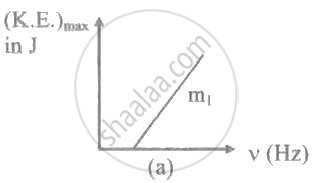
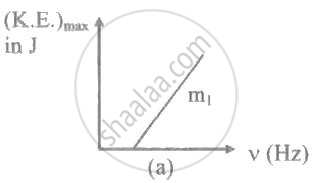
In experiment of photoelectric effect, the stopping potential for incident yellow light of wavelength 5890 Å is 4 volt. If the yellow light is replaced by blue light of wavelength 4000 Å, the stopping potential is ____________.
The stopping potential in the context of photoelectric effect depends on the following property of incident electromagnetic radiation ______.
When radiation of wavelength λ is used to illuminate a metallic surface, the stopping potential is V. When the same surface is illuminated with radiation of wavelength 3λ, the stopping potential is `"V"/4`. If the threshold wavelength for the metallic surface is nλ. then value of n will be ______.
For a given photosensitive material and frequency (> threshold frequency) of incident radiation, the photoelectric current varies with the intensity of incident light as:
