Advertisements
Advertisements
प्रश्न
In any ΔABC, with usual notations, prove that b2 = c2 + a2 – 2ca cos B.
Advertisements
उत्तर

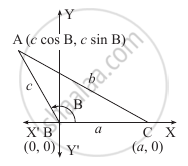
Let us take the angle B of ΔABC in standard position,
i.e. B as origin, X-axis along the line BC and the Y-axis perpendicular to the line BC.
In the two figures, ∠B is shown as acute in one and obtuse in the other.
∵ l(BC) = a
∴ C ≡ (a, 0)
Let A ≡ (x, y)
Since l (BA) = c, we have
cos B = `x/c` and sin B = `y/c`
∴ x = c cos B and y = c sin B
∴ A ≡ (c cos B, c sin B)
∴ By the distance formula
b2 = AC2 = (a – c cos B)2 + (0 – c sin B)2
= a2 – 2ca cos B + c2 cos2B + c2 sin2B
= c2(cos2B + sin2B) + a2 – 2ca cos B
∴ b2 = c2 + a2 – 2ca cos B.
APPEARS IN
संबंधित प्रश्न
In a Δ ABC, with usual notations prove that:` (a -bcos C) /(b -a cos C )= cos B/ cos A`
In ΔABC with usual notations, prove that 2a `{sin^2(C/2)+csin^2 (A/2)}` = (a + c - b)
If in ∆ABC with usual notations a = 18, b = 24, c = 30 then sin A/2 is equal to
(A) `1/sqrt5`
(B) `1/sqrt10`
(C) `1/sqrt15`
(D) `1/(2sqrt5)`
In ,Δ ABC with usual notations prove that
b2 = c2 +a2 - 2 ca cos B
Find the polar coordinates of the point whose Cartesian coordinates are `(1, - sqrt(3))`.
Find the polar co-ordinates of the point whose Cartesian co-ordinates are.
`(3/2, (3√3)/2)`.
In ΔABC, if cot A, cot B, cot C are in A.P. then show that a2, b2, c2 are also in A.P.
In any Δ ABC, prove the following:
a sin A - b sin B = c sin (A - B)
With the usual notations, show that
(c2 − a2 + b2) tan A = (a2 − b2 + c2) tan B = (b2 − c2 + a2) tan C
In Δ ABC, if a cos2 `"C"/2 + "c cos"^2 "A"/2 = "3b"/2`, then prove that a, b, c are in A.P.
If sin `(sin^-1 1/5 + cos^-1 x) = 1`, then find the value of x.
Solve: `tan^-1 ("1 - x"/"1 + x") = 1/2 (tan^-1 "x")`, for x > 0.
Solve: `tan^-1 ("1 - x"/"1 + x") = 1/2 (tan^-1 "x")`, for x > 0.
In ∆ABC, prove that ac cos B − bc cos A = a2 − b2
In ∆ABC, if sin2A + sin2B = sin2C, then show that a2 + b2 = c2
In ∆ABC, prove that `(cos^2"A" - cos^2"B")/("a" + "b") + (cos^2"B" - cos^2"C")/("b" + "c") + (cos^2"C" - cos^2"A")/("c" + "a")` = 0
In a ΔABC if 2 cos C = sin B · cosec A, then ______.
If in a right-angled triangle ABC, the hypotenuse AB = p, then `overline"AB".overline" AC" + overline"BC".overline" BA" + overline" CA".overline"CB"` is equal to ______
In Δ ABC; with usual notations, if cos A = `(sin "B")/(sin "C")`, then the triangle is _______.
In a ΔABC, 2ab sin`((A + B - C)/2)` = ______
If `(- sqrt2, sqrt2)` are cartesian co-ordinates of the point, then its polar co-ordinates are ______.
The polar co-ordinates of P are `(2, pi/6)`. If Q is the image of P about the X-axis then the polar co-ordinates of Q are ______.
In Δ ABC, with the usual notations, if `(tan "A"/2)(tan "B"/2) = 3/4` then a + b = ______.
If a = 13, b = 14, c = 15, then `cos("A"/2)` = ______.
Find the cartesian co-ordinates of the point whose polar co-ordinates are `(1/2, π/3)`.
In ΔABC with usual notations, if ∠A = 30° and a = 5, then `s/(sumsinA)` is equal to ______.
In a triangle ABC, in usual notation, (a + b + c)(b + c – a) = λbc will be true if ______.
If in a ΔABC `a cos^2(C/2) + c cos^2(A/2) = (3b)/2`, then the sides a, b and c ______.
In a triangle ABC, ∠C = 90°, then `(a^2 - b^2)/(a^2 + b^2)` is ______.
In ΔABC, with usual notations, if a, b, c are in A.P. Then `a cos^2 (C/2) + c cos^2(A/2)` = ______.
If in ΔABC, `sin A/2 * sin C/2 = sin B/2` and 2s is the perimeter of the triangle, then s = ______.
The perimeter of ΔABC is 20, ∠A = 60°, area of ΔABC = `10sqrt(3)`, then find the values of a, b, c.
If the angles A, B, C of a ΔABC are in A.P. and ∠A = 30°, c = 5, then find the values of ‘a’ and ‘b’.
With usual notations, in a triangle ABC, if θ is any real number, then a cos(B - θ) + b cos (A + θ) is
