Advertisements
Advertisements
प्रश्न
If the sum of the distances of a moving point in a plane from the axes is 1, then find the locus of the point.
Advertisements
उत्तर
Let coordinates of a moving point P be (x, y).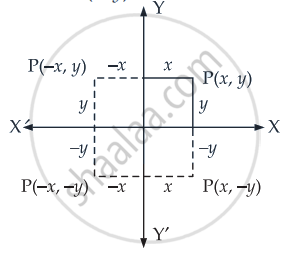
Given that the sum of the distances from the axes to the point is always 1
∴ |x| + |y| = 1
⇒ x + y = 1
⇒ – x – y = 1
⇒ – x + y = 1
⇒ x – y = 1
Hence, these equations gives us the locus of the point P which is a square.
APPEARS IN
संबंधित प्रश्न
If the lines `(x-1)/2=(y+1)/3=(z-1)/4 ` and `(x-3)/1=(y-k)/2=z/1` intersect each other then find value of k
Find the distance between parallel lines l (x + y) + p = 0 and l (x + y) – r = 0
What are the points on the y-axis whose distance from the line `x/3 + y/4 = 1` is 4 units.
Find the distance of the line 4x + 7y + 5 = 0 from the point (1, 2) along the line 2x – y = 0.
Find the direction in which a straight line must be drawn through the point (–1, 2) so that its point of intersection with the line x + y = 4 may be at a distance of 3 units from this point.
If sum of the perpendicular distances of a variable point P (x, y) from the lines x + y – 5 = 0 and 3x – 2y+ 7 = 0 is always 10. Show that P must move on a line.
Find the distance of the point (2, 3) from the line 2x − 3y + 9 = 0 measured along a line making an angle of 45° with the x-axis.
Find the distance of the point (3, 5) from the line 2x + 3y = 14 measured parallel to the line x − 2y = 1.
The perpendicular distance of a line from the origin is 5 units and its slope is − 1. Find the equation of the line.
Find the equation of a line perpendicular to the line \[\sqrt{3}x - y + 5 = 0\] and at a distance of 3 units from the origin.
What are the points on X-axis whose perpendicular distance from the straight line \[\frac{x}{a} + \frac{y}{b} = 1\] is a ?
What are the points on y-axis whose distance from the line \[\frac{x}{3} + \frac{y}{4} = 1\] is 4 units?
Show that the path of a moving point such that its distances from two lines 3x − 2y = 5 and 3x + 2y = 5 are equal is a straight line.
If sum of perpendicular distances of a variable point P (x, y) from the lines x + y − 5 = 0 and 3x − 2y + 7 = 0 is always 10. Show that P must move on a line.
If the length of the perpendicular from the point (1, 1) to the line ax − by + c = 0 be unity, show that \[\frac{1}{c} + \frac{1}{a} - \frac{1}{b} = \frac{c}{2ab}\] .
Determine the distance between the pair of parallel lines:
4x + 3y − 11 = 0 and 8x + 6y = 15
The equations of two sides of a square are 5x − 12y − 65 = 0 and 5x − 12y + 26 = 0. Find the area of the square.
Find the equation of two straight lines which are parallel to x + 7y + 2 = 0 and at unit distance from the point (1, −1).
Answer 3:
Find the equations of the lines through the point of intersection of the lines x − y + 1 = 0 and 2x − 3y+ 5 = 0, whose distance from the point(3, 2) is 7/5.
If the lines x + ay + a = 0, bx + y + b = 0 and cx + cy + 1 = 0 are concurrent, then write the value of 2abc − ab − bc − ca.
Area of the triangle formed by the points \[\left( (a + 3)(a + 4), a + 3 \right), \left( (a + 2)(a + 3), (a + 2) \right) \text { and } \left( (a + 1)(a + 2), (a + 1) \right)\]
The line segment joining the points (−3, −4) and (1, −2) is divided by y-axis in the ratio
The line segment joining the points (1, 2) and (−2, 1) is divided by the line 3x + 4y = 7 in the ratio ______.
The vertices of a triangle are (6, 0), (0, 6) and (6, 6). The distance between its circumcentre and centroid is
The shortest distance between the lines
`bar"r" = (hat"i" + 2hat"j" + hat"k") + lambda (hat"i" - hat"j" + hat"k")` and
`bar"r" = (2hat"i" - hat"j" - hat"k") + mu(2hat"i" + hat"j" + 2hat"k")` is
The distance of the point P(1, – 3) from the line 2y – 3x = 4 is ______.
Find the points on the line x + y = 4 which lie at a unit distance from the line 4x + 3y = 10.
The distance between the lines y = mx + c1 and y = mx + c2 is ______.
A point equidistant from the lines 4x + 3y + 10 = 0, 5x – 12y + 26 = 0 and 7x + 24y – 50 = 0 is ______.
The value of the λ, if the lines (2x + 3y + 4) + λ (6x – y + 12) = 0 are
| Column C1 | Column C2 |
| (a) Parallel to y-axis is | (i) λ = `-3/4` |
| (b) Perpendicular to 7x + y – 4 = 0 is | (ii) λ = `-1/3` |
| (c) Passes through (1, 2) is | (iii) λ = `-17/41` |
| (d) Parallel to x axis is | λ = 3 |
A straight line passes through the origin O meet the parallel lines 4x + 2y = 9 and 2x + y + 6 = 0 at points P and Q respectively. Then, the point O divides the segment Q in the ratio:
The distance of the point (-3, 2, 3) from the line passing through (4, 6, -2) and having direction ratios -1, 2, 3 is ______units.
The distance between the parallel lines 3x − 4y + 7 = 0 and 3x − 4y + 5 = 0 is `a/b`. Value of a + b is ______.
