Advertisements
Advertisements
प्रश्न
Identify the main product of the reaction:
\[\ce{HC ≡ C - CH3 ->[H2][Pd-C/quinoline]}\] _______.
Advertisements
उत्तर
\[\ce{HC \underset{\text{Propyne}}{≡ C - }CH3 ->[H2][Pd-C/quinoline] H2C \underset{\text{Propene}}{= CH - CH3}}\]
APPEARS IN
संबंधित प्रश्न
Predict the possible product of the following reaction.
sulphonation of chlorobenzene
Predict the possible product of the following reaction.
bromination of phenol
Predict the possible product of the following reaction.
nitration of toluene
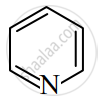
Identify giving reason whether the following compound is aromatic or not.
Give IUPAC name for the following compound.
\[\ce{CH ≡ C – C ≡ C – C ≡ CH}\]
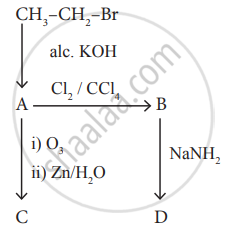
Identify the compound A, B, C and D in the following series of reactions.
Describe the mechanism of Nitration of benzene.
Suggest a simple chemical test to distinguish propane and propene.
Write the chemical equations for combustion of propane.
How does Huckel rule help to decide the aromatic character of a compound?
How will you convert ethyl chloride into ethane?
What happens when ethylene is passed through cold dilute alkaline potassium permanganate.
Write the structure of the following alkanes.
2, 3 – Dimethyl – 6 – (2 – methyl propyl) decane
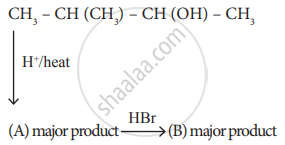
Identify A and B.
Complete the following:
\[\begin{array}{cc}
\ce{CH2 - CH2 ->[Zn/C2H5OH]}\\
|\phantom{.......}|\phantom{..............}\\
\ce{Br}\phantom{.....}\ce{Br}\phantom{..............}
\end{array}\]
When acetylene is passed through red hot iron tube at 873 K, ____________ is/are obtained as product/s.
According to Huckel rule, a cyclic π molecular orbital formed by overlap of p orbitals must contain ____________ p electrons.
Which of the following is INCORRECT for aromatic hydrocarbons?
Which of the following is NOT alicyclic compound?
Which of the following molecules has shortest C - C bond length?
Which of the following reagents can bring about following conversion?
\[\ce{But-1-ene -> Butan-2-ol}\]
Which of the following compounds is NOT obtained in thermal decomposition of propane in absence of air?
The treatment of benzene with iso - butene in the presence of sulphuric acid gives:
Read the following reaction and answer the questions given below.
\[\begin{array}{cc}
\phantom{..............................}\ce{CH3}\\
\phantom{...........................}|\\
\ce{CH3 - C = CH2 + HBr ->[benzoyl][peroxide] CH3 - CH - CH2Br}\\
|\phantom{....................................}\\
\ce{CH3}\phantom{.................................}
\end{array}\]
- Write the IUPAC name of the product.
- State the rule that governs the formation of this product.
Read the following reaction and answer the questions given below.
\[\begin{array}{cc}
\phantom{..............................}\ce{CH3}\\
\phantom{............................}|\\
\ce{CH3 - C = CH2 + HBr ->[benzoyl][peroxide]CH3 - CH - CH2Br}\\
|\phantom{....................................}\\
\ce{CH3}\phantom{.................................}
\end{array}\]
- Write IUPAC name of the product.
- State the rule that governs formation of this product.
Which of the following is most stable?
