Advertisements
Advertisements
प्रश्न
How many time constants will elapse before the current in a charging RC circuit drops to half of its initial value? Answer the same question for a discharging RC circuit.
Advertisements
उत्तर
The growth of charge across a capacitor,
\[q = Q\left( 1 - e^{- \frac{t}{RC}} \right)\]
\[q = \frac{Q}{2}\]
\[ \Rightarrow \frac{Q}{2} = Q \left( 1 - e^{- \frac{t}{RC}} \right)\]
\[ \Rightarrow \frac{1}{2} = \left( 1 - e^{- \frac{t}{RC}} \right)\]
\[ \Rightarrow e^{- \frac{t}{RC}} = \frac{1}{2}\]
\[ \Rightarrow \frac{t}{RC} = \ln 2 \]
Let t = nRC
\[ \Rightarrow \frac{nRC}{RC} = 0 . 69\]
\[ \Rightarrow n = 0 . 69\]
The decay of charge across a capacitor,
\[q = Q e^{- \frac{t}{RC}} \]
\[q = \frac{Q}{2}\]
\[ \Rightarrow \frac{Q}{2} = Q e^{- \frac{t}{RC}} \]
\[ \Rightarrow \frac{1}{2} = e^{- \frac{t}{RC}} \]
Let t = nRC
\[ \Rightarrow \frac{nRC}{RC} = \ln 2\]
\[ \Rightarrow n = 0 . 69\]
APPEARS IN
संबंधित प्रश्न
Obtain the expression for the energy stored per unit volume in a charged parallel plate capacitor.
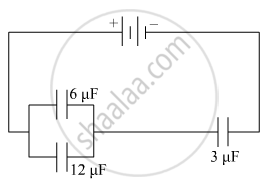
In the following arrangement of capacitors, the energy stored in the 6 µF capacitor is E. Find the value of the following :
(i) Energy stored in 12 µF capacitor.
(ii) Energy stored in 3 µF capacitor.
(iii) Total energy drawn from the battery.
A capacitor of capacitance 500 μF is connected to a battery through a 10 kΩ resistor. The charge stored in the capacitor in the first 5 s is larger than the charge stored in the next.
(a) 5 s
(b) 50 s
(c) 500 s
(d) 500 s
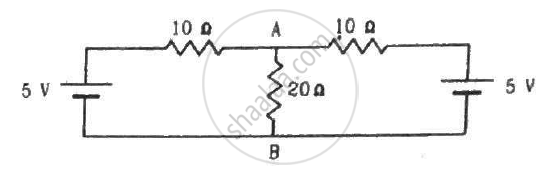
(a) Find the current in the 20 Ω resistor shown in the figure. (b) If a capacitor of capacitance 4 μF is joined between the points A and B, what would be the electrostatic energy stored in it in steady state?
A capacitance C, a resistance R and an emf ε are connected in series at t = 0. What is the maximum value of (a) the potential difference across the resistor (b) the current in the circuit (c) the potential difference across the capacitor (d) the energy stored in the capacitor (e) the power delivered by the battery and (f) the power converted into heat?
A 20 μF capacitor is joined to a battery of emf 6.0 V through a resistance of 100 Ω. Find the charge on the capacitor 2.0 ms after the connections are made.
A 100 μF capacitor is joined to a 24 V battery through a 1.0 MΩ resistor. Plot qualitative graphs (a) between current and time for the first 10 minutes and (b) between charge and time for the same period.
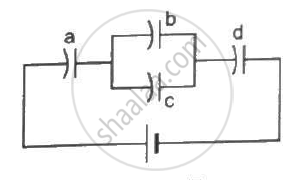
Each capacitor in figure has a capacitance of 10 µF. The emf of the battery is 100 V. Find the energy stored in each of the four capacitors.
A capacitor of capacitance 100 μF is connected across a battery of emf 6 V through a resistance of 20 kΩ for 4 s. The battery is then replaced by a thick wire. What will be the charge on the capacitor 4 s after the battery is disconnected?
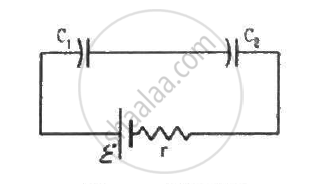
Consider the situation shown in figure. The switch is closed at t = 0 when the capacitors are uncharged. Find the charge on the capacitor C1 as a function of time t.
A capacitor of capacitance C is given a charge Q. At t = 0, it is connected to an uncharged capacitor of equal capacitance through a resistance R. Find the charge on the second capacitor as a function of time.
A large conducting plane has a surface charge density `1.0 xx 10^-4 "Cm"^-2` . Find the electrostatic energy stored in a cubical volume of edge 1⋅0 cm in front of the plane.
Choose the correct option:
Energy stored in a capacitor and dissipated during charging a capacitor bear a ratio.
A parallel plate capacitor has a uniform electric field ‘`vec "E"`’ in the space between the plates. If the distance between the plates is ‘d’ and the area of each plate is ‘A’, the energy stored in the capacitor is ______
(ε0 = permittivity of free space)
A parallel plate capacitor (A) of capacitance C is charged by a battery to voltage V. The battery is disconnected and an uncharged capacitor (B) of capacitance 2C is connected across A. Find the ratio of total electrostatic energy stored in A and B finally and that stored in A initially.
What is called the energy stored in a capacitor?
What is the SI unit of energy stored in a capacitor?
If an additional small charge \(dq\) is supplied to a capacitor when its potential difference is \(V\), what is the small work done?
Using \(Q=CV\), which expression is an equivalent form of \(U=\frac{Q^2}{2C}\)?
