Advertisements
Advertisements
प्रश्न
How can these impurities be removed?
Advertisements
उत्तर
- The impurities can be removed from hydrogen by passing it through
- Silver nitrate solution to remove arsine and phosphine.
AsH3 + 6AgNO3 → Ag3As + 3AgNO3 + 3HNO3
PH3 + 6AgNO3 → Ag3P + 3AgNO3 + 3HNO3
- Lead nitrate solution to remove hydrogensulphide.
Pb(NO3)2 + H2S → Pbs + 2HNO3
- Caustic potash solution to remove sulphur dioxide, carbon dioxide and oxides of nitrogen.
SO2 + 2KOH → K2SO3 + H2O
CO2 + 2KOH→ K2CO3+ H2O
2NO2 + 2KOH →KNO2 + KNO3 + H2O
- A drying agent used to dry the gas. Common drying agents such as fused calcium chloride, caustic potash stick and phosphorus pentoxide remove water vapor.
So, the gas is purified and dried and then collected over mercury because mercury does not react with it.
APPEARS IN
संबंधित प्रश्न
Indicate which of the following statement is true and which is false:
Nitric acid cannot be used to prepare hydrogen by its action on active metals.
How would you show that hydrogen is a non-supporter of combustion?
FILL IN THE BLANK
Sodium liberates hydrogen when treated with cold .............
TRUE \ FALSE
Lead reacts briskly with dilute hydrochloric acid to form hydrogen.
Give a test to identify hydrogen ?
Give reason:
Apparatus for laboratory preparation of hydrogen should be airtight and away from a naked flame.
Name the following.
A gaseous reducing agent which is basic in nature.
The diagram represent the preparation and collection of hydrogen by a standard laboratory method.
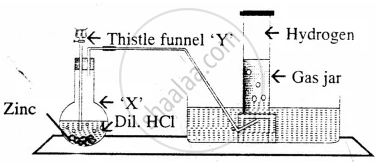
State what difference will be seen if pure zinc is added in the distillation flask ‘X’ instead of granulated zinc.
The diagram represent the preparation and collection of hydrogen by a standard laboratory method.
State, why hydrogen is collected after all the air in the apparatus, is allowed to escape.
The diagram represent the preparation and collection of hydrogen by a standard laboratory method.
Name a gas other than hydrogen collected by the same method.
