Advertisements
Advertisements
प्रश्न
Name the following.
A gaseous reducing agent which is basic in nature.
Advertisements
उत्तर
Ammonia gas \[\ce{(NH3)}\]
APPEARS IN
संबंधित प्रश्न
Name the following:
A metallic oxide which can be reduced into metal by hydrogen.
Why is granulated zinc preferred in the laboratory preparation of hydrogen?
How would you show that hydrogen is lighter than air?
Starting from zinc how would you obtain hydrogen using an alkali.
[Give balanced equation & name the product formed in the case other than hydrogen].
Name a metal which will not react with the reactants above to give hydrogen.
In the laboratory preparation of hydrogen from zinc & dilute hydrocholoric acid – state a reason for the addition of traces of copper [II] sulphate to the reaction medium.
Draw neat labelled diagrams for two different experiments to prove that – hydrogen is lighter than air.
Give reason for the following:
Copper does not displace hydrogen from dilute hydrochloric acid, but zinc does.
Select the correct answer from the symbol in the bracket.
The element which forms a diatomic molecule.
The diagram represent the preparation and collection of hydrogen by a standard laboratory method.
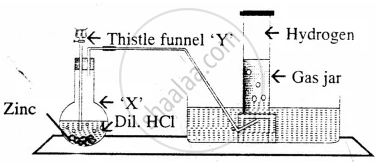
State what difference will be seen if pure zinc is added in the distillation flask ‘X’ instead of granulated zinc.
The diagram represent the preparation and collection of hydrogen by a standard laboratory method.
Name a solution which absorbs the impurity – `"H"_2"S"`
