Advertisements
Advertisements
प्रश्न
Given below are the speed -time graphs. Match them with their corresponding motions :
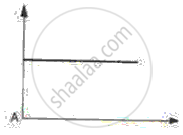 |
(a) Uniformity retared motion |
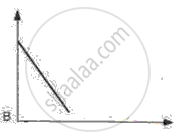 |
(b) Non-uniformity acceleration |
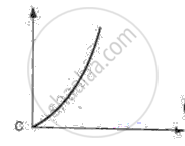 |
(c) Non-uniform motion |
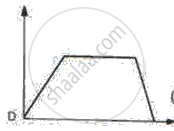 |
(d) uniform motion |
Advertisements
उत्तर
|
(d) uniform motion |
|
(a) Uniformity retared motion |
|
(b) Non-uniformity acceleration |
|
(c) Non-uniform motion |
APPEARS IN
संबंधित प्रश्न
The velocity-time graph for part of a train journey is a horizontal straight line. What does this tell you about the trains velocity.
What type of motion is represented by the following graph ?
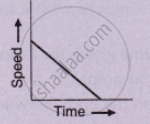
Draw a displacement-time graph for a boy going to school with uniform velocity.
A train starting from rest picks up a speed of 20 ms−1 in 200 s. It continues to move at the same rate for the next 500 s and is then brought to rest in another 100 s.
- Plot a speed-time graph.
- From graph calculate
(a) uniform rate of acceleration
(b) uniform rate of retardation
(c) total distance covered before stopping
(d) average speed.
From the velocity – time graph given below, calculate Average velocity in region CED.
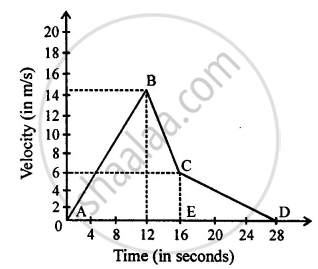
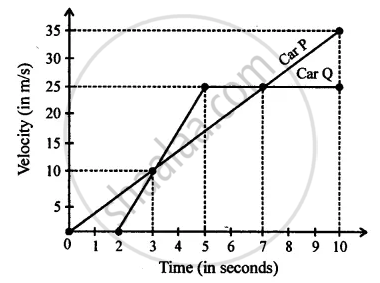
Diagram is given below shows velocity – time graph of car P and Q, starting from the same place and in the same direction. Calculate which car is ahead after 10 s and by how much?
Interpret the following graph: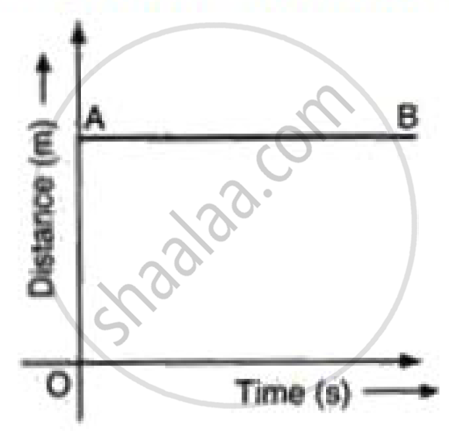
Sketch the shape of the velocity-time graph for a body moving with:
Uniformly velocity
Draw the distance-time graphs of the bodies P and Q starting from rest, moving with uniform speeds with P moving faster than Q.
The slope of the speed–time graph gives ______.
