Advertisements
Advertisements
प्रश्न
Find the odd one out and give its explanation.
विकल्प
Voltmeter
Ammeter
Galvanometer
Electric motor
Advertisements
उत्तर
Electric motor.
Explanation:
- A voltmeter, ammeter, and galvanometer are all measuring instruments used to detect or measure electrical quantities (potential difference, current, and the presence of small currents, respectively).
- An electric motor is an electromechanical device that converts electrical energy into mechanical energy, rather than functioning as a measuring instrument.
APPEARS IN
संबंधित प्रश्न
Write down the electronic configuration of the following elements from the given atomic numbers. Answer the following question with explanation.
1H, 7N, 20Ca, 16S, 4Be, 18Ar Which of these elements belong to the second group?
Write down the electronic configuration of the following elements from the given atomic numbers. Answer the following question with explanation.
7N, 6C, 8O, 5B, 13Al Which is the most electronegative element among these?
Write down the electronic configuration of the following elements from the given atomic numbers. Answer the following question with explanation.
11Na, 15P, 17Cl, 14Si, 12Mg Which of these has largest atoms?
Write down the electronic configuration of the following elements from the given atomic numbers. Answer the following question with explanation.
6C, 3Li, 9F, 7N, 8O Which of the above elements has the highest nonmetallic character?
Which of this element belong to the period 3? Write their electronic configuration
`3^(Li) , 14^(Si) , 2^(He) , 15^(P)`
An element has its electron configuration as 2, 8, 2. Now answer the following question.
Which of the following elements would this element resemble?
(Atomic numbers are given in the brackets)
N(7), Be(4), Ar(18), Cl(17)
Which pair of atomic numbers represents elements in the same group?
Which among the following is the largest element?
Find the odd one out and give its explanation.
Find the odd one out and give its explanation.
Answer the following question in one sentence.
Write the name of an element having electronic configuration 2,8,2.
Match the columns.
| Column A | Column B |
| 1) Alkaline earth metals | a) Group 18 |
| 2) Alkali metals | b) Group 17 |
| 3) Halogen | c) Group 2 |
| 4) Noble gas | d) Group 1 |
| e) Group 14 |
Write the name.
The group of elements having electronic configuration 2, 2.
Right or wrong sentence.
The valency of the elements in group 2 is 1.
Beryllium and calcium are alkaline earth metals.
Complete the following chart.
| Shell | n | 2n2 | Electron holding capacity |
| K | 2 × 12 | 2 | |
| L | 2 | 8 | |
| 3 | 2 × 32 | 18 | |
| N | 4 | 2 × 42 |
Identify periods of elements and blocks of elements from given electronic configuration.
- 2, 8, 2
- 2, 8, 7
- 2, 1
XY compound is formed by X (Atomic number 11) and Y (Atomic number 17), then answer the questions given below.
- Determine the position of the element X and Y periodic table.
- Which type of elements X and Y are metals, nonmetals or metalloids?
- From which block the elements X and Y are?
- Determine the electronic configuration and valency of these elements.
Observe the periodic table given below and write the answers of the questions.
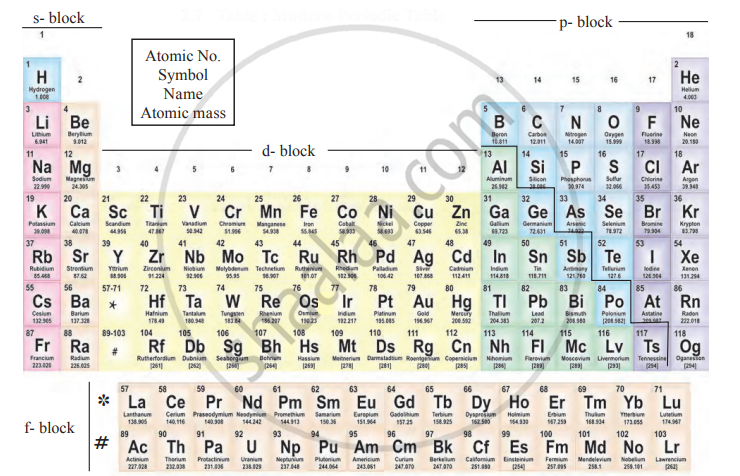
- Write the name and valencies of the elements in 3rd row.
- Classify the elements in this row as metal, nonmetal and metalloids.
- Which block does nonmetals belong to?
- Write name of any two metalloid elements.
