Advertisements
Advertisements
प्रश्न
Find the area of a trapezium whose parallel sides are 24 cm and 20 cm and the distance between them is 15 cm
Advertisements
उत्तर
Given the parallel sides a = 24 cm, b = 20 cm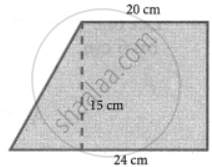
Distance between a and b is ‘h’ = 15 cm
Area of the trapezium = `1/2` × h × (a + b) sq.units
= `1/2` × 15 × (24 + 20) cm2
= `1/2` × 15 × 44 = 330 cm2
Area of the trapezium = 330 cm2
APPEARS IN
संबंधित प्रश्न
Find the area of a trapezium whose parallel sides are of length 16 dm and 22 dm and whose height is 12 dm.
The area of a trapezium is 960 cm2. If the parallel sides are 34 cm and 46 cm, find the distance between them.
There is a pentagonal shaped park as shown in Fig. 20.50. Jyoti and Kavita divided it in two different ways.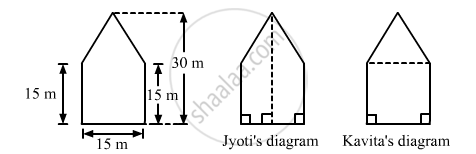
Find the area of this park using both ways. Can you suggest some another way of finding its areas?
The two parallel sides and the distance between them are in the ratio 3: 4: 2. If the area of the trapezium is 175 cm2, find its height.
Find the missing values.
| Height 'h' | Parallel side 'a` | Parallel side 'b` | Area |
| 10 m | 12 m | 20 m |
Find the missing values.
| Height 'h' | Parallel side 'a` | Parallel side 'b` | Area |
| 16 cm | 15 cm | 360 sq.cm |
The area of a trapezium is 1080 sq.cm. If the lengths of its parallel sides are 55.6 cm and 34.4 cm. Find the distance between them
The sunshade of a window is in the form of isosceles trapezium whose parallel sides are 81 cm and 64 cm and the distance between them is 6 cm. Find the cost of painting the surface at the rate of ₹ 2 per sq.cm
The areas of two circles are in the ratio 49 : 64. Find the ratio of their circumferences.
Find the area of the following fields. All dimensions are in metres.

