Advertisements
Advertisements
प्रश्न
Fill in the blanks to complete the summary.
Ever since their introduction, ______, and their unique rhythms have ______ poets. In this poem the poet shares his experience ______ with us. He presents natural scenes seen from ______ a railway carriage. The ______ is regular and steady but ______ from the window of the train is constantly changing. The poem’s rhythm and phrases bring ______ of a railway journey. The poet looks out of the window at the ______ images outside. Every line we see here is a quick account of something seen for ______. The line that best sums up is the final one: "Each a glimpse and gone forever!"
Advertisements
उत्तर
Ever since their introduction, rhymes, and their unique rhythms have inspired poets. In this poem the poet shares his experience of a Journey in a Railway Carriage with us. He presents natural scenes seen from the window a railway carriage. The rhythm of the lines is regular and steady but the view from the window of the train is constantly changing. The poem’s rhythm and phrases bring speed and exhilaration of a railway journey. The poet looks out of the window at the fast moving array of images outside. Every line we see here is a quick account of something seen for short moment.. The line that best sums up is the final one: "Each a glimpse and gone forever!"
APPEARS IN
संबंधित प्रश्न
How has the poet brought out her emotional attachment to her mother tongue?
What quality of 'beauty' and 'love' does the poem highlight?
Read the lesson and name the following.
A sack around the heart ______
Make a list of functions/events/programs/activities organized in your junior college. Choose three events and plan a program schedule of your own. Prepare a script as well to show the associating role of the compere for a particular event. Make your own sequence and design a template for the same.
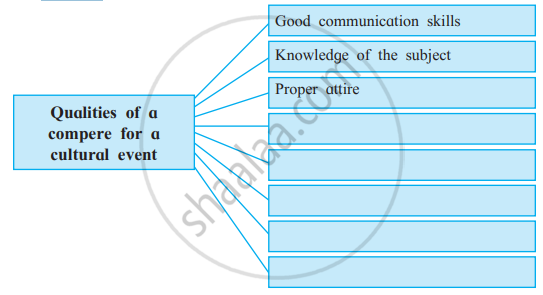
Imagine that you wish to organize a cultural event at your college. Prepare your own web-chart to indicate the qualities that you expect to have in a compere.
What changes in the stage setting would you suggest.
Write the symbol that is used in the poem to represent the following idea.
It was tempting and needed to be tried.
Who said the following, to whom, and when?
"Ah no, to thee I sing: he sings to God.”
They would rest on the tree.
Find and write the clues.
Clue for blind eye ______
