Advertisements
Advertisements
प्रश्न
Draw a diagram to show the forces acting on a body floating in water with its some part submerged. Name the forces and show their points of application. How is the weight of water displaced by the floating body related to the weight of the body itself?
Advertisements
उत्तर
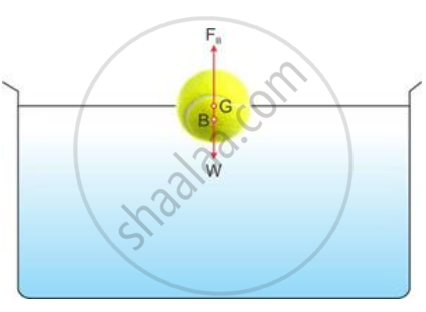
The forces acting are as listed below:
(i) Weight of the body acting downwards.
(ii) Upthrust due to water acting upwards.
Weight of water displaced by the floating body = Weight of the body
APPEARS IN
संबंधित प्रश्न
When a piece of wood is suspended from the hook of a spring balance, it reads 70 gf. The wood is now lowered into water. What reading do you expect on the scale of spring balance?
An iron nail sinks in the water while an iron ship floats on water. Explain the reason.
A hollow metal cylinder of length 10 cm floats in alcohol of density 0.80 g cm-3, with 1 cm of its length above it. What length of cylinder will be above copper sulphate solution of density 1.25 g cm-3?
A test tube weighing 17 gf, floats in alcohol to the level P. When the test tube is made to float in water to the level P, 3 gf of the lead shots are added in it. find the R.D. of alcohol.
A test tube loaded with lead shots weighs 25 gf and floats upto the mark X in water. When the test tube is made to float in brine solution, it needs 5 gf more of lead shots to float upto level X. Find the relative density of brine solution.
Name an instrument based on this principle. State two uses of the instrument that you describe.
Explain the following:
A hydrometer is made heavy near the bottom.
How does an object’s density determine whether the object will sink or float in water?
If you put one ice cube in a glass of water and another in a glass of alcohol, what would you observe? Explain your observations.
Where do we use lactometers?
