Advertisements
Advertisements
प्रश्न
Find the number of molecules of an ideal gas in a volume of 1.000 cm3 at STP.
Advertisements
उत्तर
Here,
Volume of ideal gas at STP = 22.4 L
Number of molecules in 22.4 L of ideal gas at STP = 6.022\[\times\]1023
Number of molecules in 22.4\[\times\]103 cm3 of ideal gas at STP = 6.022\[\times\]1023
Now,
Number of molecules in 1 cm3 of ideal gas at STP =\[\frac{6 . 022 \times {10}^{23}}{22 . 4 \times {10}^3} = 2 . 688 \times {10}^{19}\]
APPEARS IN
संबंधित प्रश्न
Consider a gas of neutrons. Do you expect it to behave much better as an ideal gas as compared to hydrogen gas at the same pressure and temperature?
When you come out of a river after a dip, you feel cold. Explain.
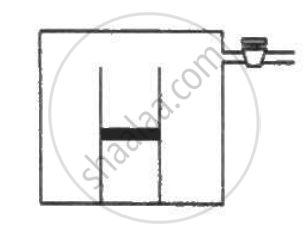
An ideal gas is kept in a long cylindrical vessel fitted with a frictionless piston of cross-sectional area 10 cm2 and weight 1 kg in figure. The vessel itself is kept in a big chamber containing air at atmospheric pressure 100 kPa. The length of the gas column is 20 cm. If the chamber is now completely evacuated by an exhaust pump, what will be the length of the gas column? Assume the temperature to remain constant throughout the process.
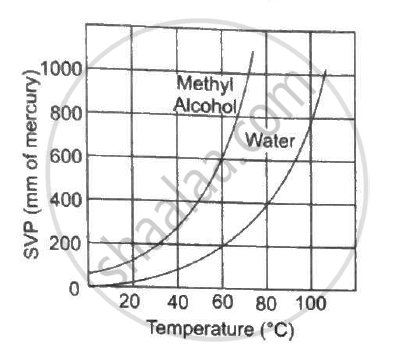
Using figure, find the boiling point of methyl alcohol at 1 atm (760 mm of mercury) and at 0.5 atm.
In an ideal gas, the molecules possess ______.
On what, the values of absorption coefficient, reflection coefficient, and transmission coefficient depend, in addition to the material of the object on which the radiation is an incident?
Compare the rate of radiation of metal bodies at 727 °C and 227 °C.
Explain in detail the kinetic interpretation of temperature.
The graph of kinetic energy against the frequency v of incident light is as shown in the figure. The slope of the graph and intercept on X-axis respectively are ______.

Average kinetic energy of H2 molecule at 300K is 'E'. At the same temperature, average kinetic energy of O2 molecule will be ______.
An ideal gas in a container of volume 500 cc is at a pressure of 2 × 10⁵ N/m2. The average kinetic energy of each molecule is 6 × 10⁻²¹ J. The number of gas molecules in the container is ______.
A cylinder containing an ideal gas is in vertical position and has a piston of mass M that is able to move up or down without friction (Figure). If the temperature is increased ______.

An inflated rubber balloon contains one mole of an ideal gas, has a pressure p, volume V and temperature T. If the temperature rises to 1.1 T, and the volume is increased to 1.05 V, the final pressure will be ______.
Two molecules of a gas have speeds of 9 × 10 6 ms−1 and 1 × 10⁶ ms−1, respectively. What is the root mean square speed of these molecules?
23Ne decays to 23Na by negative beta emission. Mass of 23Ne is 22.994465 amu mass of 23Na is 22.989768 amu. The maximum kinetic energy of emitted electrons neglecting the kinetic energy of recoiling product nucleus is ______ MeV.
When the temperature of an ideal gas is increased from 27°C to 227°C, its speed is changed from 400 ms-1 to vs, and Then vs is ______.
If a = 0. 72 and t = 0.04, then the value of r is ______.
2000 calories of radiant heat is incident on a body. If the body absorbs 550 calories of heat, find the coefficient of emmission of the body.
