Advertisements
Advertisements
प्रश्न
Describe protein digestion in the human.
Advertisements
उत्तर
Digestion of proteins in humans:
There is no digestion of protein in the oral cavity because protein digestive enzymes are absent in the saliva.
1. Digestion of protein in the stomach:
Gastric juice contains HCl and two proenzyme, pepsinogen and prorennin. HCI maintains a pH of 2 - 3.7 and kills bacteria and other pathogens. Gastric juice mixes with food until it becomes semi-solid mass called Chyme. Proenzymes become activated as below:
These enzymes act as follows:
2. Digestion of protein the small intestine
Action of pancreatic juice. It contains proenzymes trypsinogen, chymotry-psinogen and procarboxy peptidase.
Action of intestinal juice. Intestinal juice contains endokinase, aminopeptidase and dipeptidase. Actions of these enzymes are summarized below:
Peptides —Aminopentidase _. cm aller peptides + Amino acid
Peptides —Dipentidase_. amino acid
APPEARS IN
संबंधित प्रश्न
Which part of the digestive canal is involved in:
Absorption of food ______.
Which of the organs performs the function in humans?
Absorption of food
What is meant by dental caries?
Define the terms 'nutrients'.
Define the following term :
Pylorus
Give Scientific reasons:
Consuming iodized salt in day to day diet is essential.
Write one function each of the following enzymes:
Lipase
State the four ways in which saliva is useful to us.
Fill in the blank.
Saliva contains salivary amylase which changes starch to _____.
Write short answers
Write the names of three enzymes which are found in pancreatic juice.
Answer in detail.
What happens to the nutrients absorbed in the bloodstream from the small intestine?
Define with examples: Omnivores
State one difference in nutrition: Autotroph and Heterotroph
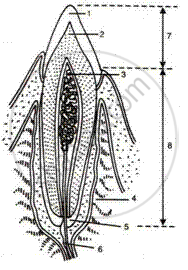
Observe the diagram given alongside and answer the following:
- Name the parts numbered 1-8.
- Which parts shown in the diagram are non-living?
- Is the tooth suited for cutting, tearing or grinding?
- What is the function of parts 8 and 7?
- What is the total number of teeth present in adult human beings?
- Write the dental formula of human beings.
Describe the human alimentary canal.
The other name of food pipe is alimentary canal.
Identify the labels i, ii, iii, and iv in the given diagram of tooth anatomy.

Select the correct pair of peptide hormones secreted by the alimentary canal.
Which part of the alimentary canal receives bile from the liver?
The complete digestion and absorption of nutrients is done by the small intestine. Which of the following greatly enhances the process of absorbtion?
