Advertisements
Advertisements
प्रश्न
Define a taxon. What is meant by taxonomic hierarchy. Give a flow diagram from the lowest to highest category for a plant and an animal. What happens to the number of individuals and number of shared characters as we go up the taxonomical hierarchy?
Advertisements
उत्तर
A taxon is a level of biological taxonomy, such as phylum, order, family, and so on.
Taxonomic Hierarchy: Distinct taxa have different levels in taxonomy. This means that a specific taxon will only appear after another specific taxon. Species, for example, always come after the genus and never the other way around.
Plant Categories Flow Chart
Kingdom→Division→Class→Order→Family→Genus→Species
Flow Chart of Animal Categories
Kingdom→Phylum→Class→Order→Family→Genus→Species
The common characteristics decrease as we progress up the taxonomic ladder. All members of a species, for example, will have the greatest amount of common traits. All members of a genus, on the other hand, will have a smaller number of common characters. The number of individuals increases as we go up the taxonomic hierarchy.
APPEARS IN
संबंधित प्रश्न
Give some examples of taxa at different hierarchical levels.
Define and understand the following term:
Phylum
Define and understand the following term:
Family
Define and understand the following term:
Genus
Find the odd one out. Give reason.
jellyfish, hydra, sea anemone, butterfly
______ is a cold blooded animal.
Which among the following have scales?
- Amphibians
- Pisces
- Reptiles
- Mammals
Which is not an aquatic animal?
Amphibians do not have the following
Corals are
Classify the following organisms based on the absence/presence of true coelom (i.e., acoelomate, pseudocoelomate and coelomate)
Spongilla, Sea anemone, Planaria, Liver fluke Wuchereria, Ascaris, Nereis, Earthworm, Scorpion, Birds, Fishes, Horse.
Label a,b,c and d. given in Fig. 7.1 Give the function of (b)
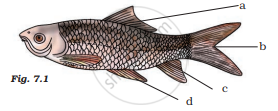
Write names of few thallophytes. Draw a labelled diagram of Spirogyra.
Paired and jointed legs are seen in phylum ______.
Order is a number of related families having common characters placed in an order.
Identity the incorrect statement:
In the taxonomical hierarchy, the category below the level of order is ______.
Which one of the following belongs to the family Muscidae?
Which of the following ‘suffixes’ used for units of classification in plants indicates a taxonomic category of ‘family’?
Brinjal and potato belong to the same genus Solanum, but to two different species. What defines them as seperate species?
