Advertisements
Advertisements
प्रश्न
Define and understand the following term:
Phylum
Advertisements
उत्तर
Classes comprising animals like fish, amphibians, reptiles, birds, and mammals constitute the next higher category called phylum. All these, based on common features like the presence of the notochord and dorsal hollow neural system, are included in the phylum Chordata. In the case of plants, classes with a few similar characters are assigned to a higher category called division.
APPEARS IN
संबंधित प्रश्न
Give some examples of taxa at different hierarchical levels.
Name one example of the animal which shows the following characteristics:
Fixed animals with a pore-bearing body:
Find the odd one out. Give reason.
sea urchin, starfish, brittle star, jellyfish
______ is a cold blooded animal.
Identify my class/phylum and give one example of it:
I have mammary glands and exoskeletons in the form of hair.
Which among the following have scales?
- Amphibians
- Pisces
- Reptiles
- Mammals
Amphibians do not have the following
______ has smallest number of organisms with maximum number of similar characters
Classify the following organisms based on the absence/presence of true coelom (i.e., acoelomate, pseudocoelomate and coelomate)
Spongilla, Sea anemone, Planaria, Liver fluke Wuchereria, Ascaris, Nereis, Earthworm, Scorpion, Birds, Fishes, Horse.
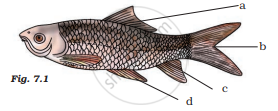
Label a,b,c and d. given in Fig. 7.1 Give the function of (b)
Which is not an insect?
In the system of classification, which one of the following is NOT a category?
Identity the incorrect statement:
As we go from species to kingdom in a taxonomic hierarchy, the number of common characteristics ______.
Which of the following ‘suffixes’ used for units of classification in plants indicates a taxonomic category of ‘family’?
Define a taxon.
Which one of the following statements refers to Reductionist Biology?
