Advertisements
Advertisements
प्रश्न
Define and understand the following term:
Phylum
Advertisements
उत्तर
Classes comprising animals like fish, amphibians, reptiles, birds, and mammals constitute the next higher category called phylum. All these, based on common features like the presence of the notochord and dorsal hollow neural system, are included in the phylum Chordata. In the case of plants, classes with a few similar characters are assigned to a higher category called division.
APPEARS IN
संबंधित प्रश्न
Give some examples of taxa at different hierarchical levels.
Name one example of the animal which shows the following characteristics:
Fixed animals with a pore-bearing body:
Identify my class/phylum and give one example of it:
I have mammary glands and exoskeletons in the form of hair.
Which is not an aquatic animal?
Amphibians do not have the following
Which of the following is not a criterion for classification of living organisms?
Write true (T) or false (F)
Starting from Class, Species comes before the Genus.
You are provided with the seeds of gram, wheat, rice, pumpkin, maize, and pea. Classify them whether they are monocot or dicot.
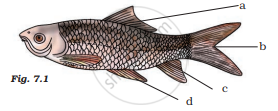
Label a,b,c and d. given in Fig. 7.1 Give the function of (b)
Animals belonging to phylum protozoa reproduce by fission.
In the system of classification, which one of the following is NOT a category?
Identity the incorrect statement:
Which of the following ‘suffixes’ used for units of classification in plants indicates a taxonomic category of ‘family’?
Match the following and choose the correct option:
| Column I | Column II |
| A. Family | i. Tuberosum |
| B. Kingdom | ii. Polymoniales |
| C. Order | iii. Solanum |
| D. Species | iv. Plantae |
| E. Genus | v. Solanacea |
International Code of Botanical Nomenclature (ICBN) has provided a code for classification of plants. Give hierarchy of units of classification botanists follow while classifying plants and mention different ‘Suffixes’ used for the units.
What is the difference between flora, fauna and vegetation? Eichhornia crassipes is called as an exotic species while Rauwolfia serpentina is an endemic species in India. What do these terms exotic and endemic refer to?
Define a taxon.
