Advertisements
Advertisements
प्रश्न
Amphibians do not have the following
पर्याय
Three chambered heart
Gills or lungs
Scales
Mucus glands
Advertisements
उत्तर
Scales
Explanation -
Amphibians do not have scales, instead, their skin has mucous secreting glands.
Fish, along with reptiles, have hard protective scales on their skin for protection. The outer body of many fish is covered with scales, which are part of the fish’s integumentary system. The scales originate from the mesoderm (skin). One major characteristic of reptiles is the presence of scales composed of a protein called keratin. These scales form a waterproof barrier of the skin, which allows reptiles to exist away from water without the threat of dehydration. Amphibians use their skin as secondary respiratory surfaces. Their skin is permeable to water and gases and is lined by mucous.
APPEARS IN
संबंधित प्रश्न
Try to collect all the currently accepted meanings for the word ‘species’. Discuss with your teacher the meaning of species in the case of higher plants and animals on one hand and bacteria on the other:
Define and understand the following term:
Family
Define and understand the following term:
Genus
Name one example of the animal which shows the following characteristics:
Fixed animals with a pore-bearing body:
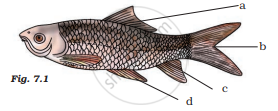
Label a,b,c and d. given in Fig. 7.1 Give the function of (b)
Animals belonging to phylum protozoa reproduce by fission.
Identity the incorrect statement:
Which of the following ‘suffixes’ used for units of classification in plants indicates a taxonomic category of ‘family’?
Match the following and choose the correct option:
| Column I | Column II |
| A. Family | i. Tuberosum |
| B. Kingdom | ii. Polymoniales |
| C. Order | iii. Solanum |
| D. Species | iv. Plantae |
| E. Genus | v. Solanacea |
Define a taxon.
