Advertisements
Advertisements
प्रश्न
Complete the following enzymatic reaction.
Maltose \[\ce{->[maltase]}\] ___________
Advertisements
उत्तर
Maltose \[\ce{->[maltase]}\] glucose
APPEARS IN
संबंधित प्रश्न
What is the function of digestive enzymes?
Explain the process of digestion of food in mouth, stomach and small intestine in human body.
Consider the following two statements A and B and select the right option from (i)-(iv) about their correctness.
- Small intestine is shorter than large intestine.
- Small intestine is wider than large intestine.
Options :
(i)Both the statements are correct
(ii) Both the statements are wrong
(iii) Statement A is correct, B is wrong
(iv) Statement B is correct, A is wrong
Study the diagram given below and then answer the question that follows:
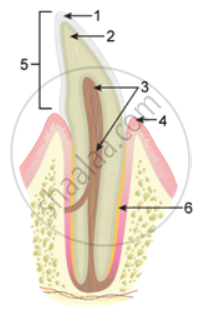
Give the total number of the type of tooth mentioned in '1' above, in the mouth of an adult and state its function.
Fill in the blanks.
Pepsin acts on ________ to change them into _______ and __________.
Mark odd one in the series:
Write down the explanation.
Explain the structure of tooth.
Bile helps in the digestion of ______.
Match the two columns and select correct option.
| Column - I | Column - II | ||
| i. | Sphincter of Oddi | a. | Oesophagus and stomach |
| ii. |
Ileo-caecal sphincter |
b. | Stomach and small intestine |
| iii. | Pyloric sphincter | c | Ileum and caecum |
| iv. |
Gastro-oesophageal sphincter |
d. | Opening of hepato- pancreatic duct |
What are the end products of digestion of starch, proteins, and fats respectively?
