Advertisements
Advertisements
प्रश्न
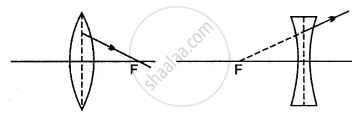
Complete the following diagram and state what happens to the ray of light after refraction through the lens.
Advertisements
उत्तर
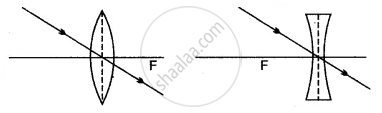
A ray of light that passes through the principal focus or appears to pass through the principal focus, goes parallel to its principal axis.
संबंधित प्रश्न
In figure, (a) and (b), F1 and F2 are the two foci of thin lenses and AB is the incident ray. Complete the diagram to show the path of the ray AB after refraction through each lens.
 |
| (a) |
 |
| (b) |
A ray of light after refraction through a lens emerges parallel to the principal axis of the lens. The incident ray either passes through ______.
A ray of light incident on a lens parallel to its principal axis, after refraction passes through or appears to come from ______.
For an object placed at a distance 20 cm in front of a convex lens, the image is at a distance 20 cm behind the lens. The focal length of the convex lens is ______.
Define the term focus of a lens.
Fig. shows two rays of light Op and OQ coming from an object at the bottom of a pond, incident on the water surface.
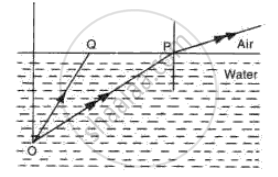
(a) Mark on the diagram
(i) The angle of incidence of ray OP,
(ii) The angle of refraction of ray Op,
(iii) The position of image of the object as seen from above.
(iv) An approximate path of the ray OQ.
(b) Explain, why do the rays of light change directions on passing from water to air.
(c) A fish in water sees everything outside the water by rays of light entering its eye in a small cone of light. Draw a diagram and explain how does this happen.
A lens forms the image of an object placed at a distance of 45 cm from it on a screen placed at a distance 90 cm on the other side of it. Name the kind of lens.
In the following diagram, L1 and L2 are the two convex lense placed at separation equal to the sum of focal lengths of the two lenses. A and B are the two rays of light incident on the lens L1. Complete the path of rays till they emerge out of the lens L2.
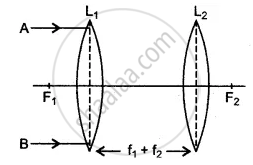
What principles have you used in completing the diagram?
