Advertisements
Advertisements
प्रश्न
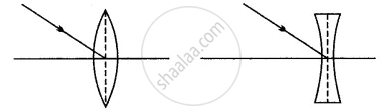
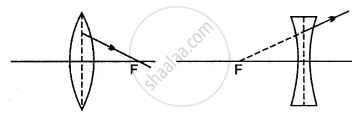
Complete the following diagram and state what happens to the ray of light after refraction through the lens.
Advertisements
उत्तर
A ray of light that passes through the principal focus or appears to pass through the principal focus, goes parallel to its principal axis.
संबंधित प्रश्न
Explain optical centre of a lens with the help of proper diagram(s).
State the condition when a lens is called an equi-convex or equi-concave.
A ray of light incident on a lens parallel to its principal axis, after refraction passes through or appears to come from ______.
Study the diagram shown in Fig. 5.56
Complete the diagram to show the formation of image A’B’ of the object AB of same size.
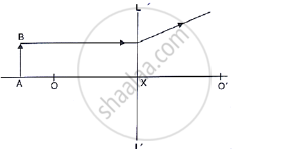
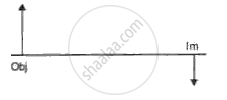
In the following diagram ., the object and the image formed by the respective lenses are shown. Complete the ray diagram, and locate the focus. Find the focal length of the lens.
A lens used as a magnifying glass
- is a diverging lens
- produces a virtual image
- is placed with the object nearer the lens than the principal focus
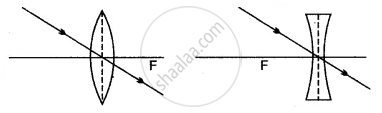
When does a ray of light falling on a lens pass through it undeviated?
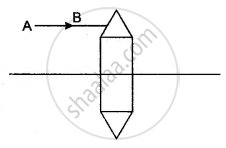
The diagram showed a lens as a combination of one glass block and two prisms. Complete the ray diagram and show the part of the incident ray AB after passing through the lens.
(i) Name of the lens formed by the combination.
(ii) What is the line XX’ called?
(iii) Mark the focus F.
Complete the following diagram and state what happens to the ray of light after refraction through the lens.
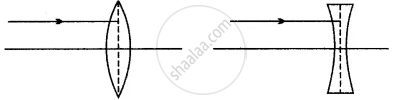
Complete the following diagram and state what happens to the ray of light after refraction through the lens.