Advertisements
Advertisements
प्रश्न
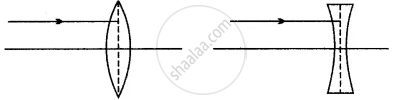
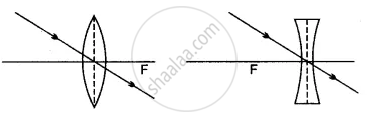
Complete the following diagram and state what happens to the ray of light after refraction through the lens.
Advertisements
उत्तर
A ray of light parallel to the principal axis, after refraction by the lens, either passes through its principal focus or appear to pass through its principal focus.
संबंधित प्रश्न
What is a lens?
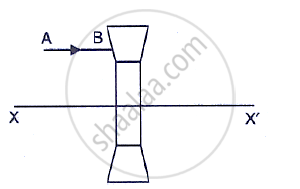
The diagram below shows a lens as a combination of a glass slab and two prisms.
- Name the lens formed by the combination.
- What is the line XX’ called?
- Complete the path of the incident ray AB after passing through the lens.
- The final emergent ray either meets XX’ at a point or appears to come from a point on XX’. Label it as F. What is this point called?
The diagram given below shows the position of an object OA in relation to a converging lens whose foci are at F1 and F2.
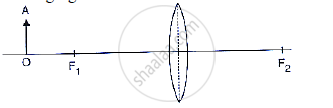
Describe three characteristic of the image.
State the condition of the following:
A ray passes undeviated through the lens.
In the following diagram ., the object and the image formed by the respective lenses are shown. Complete the ray diagram, and locate the focus. Find the focal length of the lens.
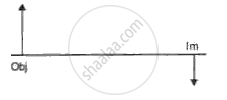
In the following diagram , the object and the image formed by the respective lenses are shown. Complete the ray diagram, and locate the focus. Find the focal length of the lens.
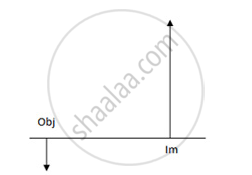
Define the term focus of a lens.
Name the subjective property of light related to its wavelength.
When does a ray of light falling on a lens pass through it undeviated?
Draw a ray diagram to show the image formed by a convex lens when the object is placed between F and 2F.
