Advertisements
Advertisements
प्रश्न
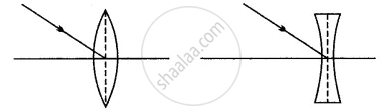
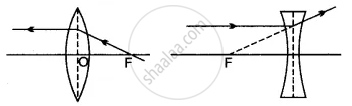
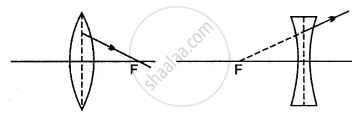
Complete the following diagram and state what happens to the ray of light after refraction through the lens.
Advertisements
उत्तर
A ray of light goes undeviated through the optical centre of a lens, whether convex or concave.
संबंधित प्रश्न
Study the diagram shown in the following Figure.
Name the lens LL’ and draw its outline.
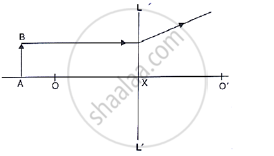
A ray of light incident parallel to the principal axis of a lens, passes undeviated after refraction.
In the following diagram ., the object and the image formed by the respective lenses are shown. Complete the ray diagram, and locate the focus. Find the focal length of the lens.
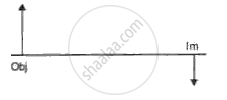
In the following diagram , the object and the image formed by the respective lenses are shown. Complete the ray diagram, and locate the focus. Find the focal length of the lens.
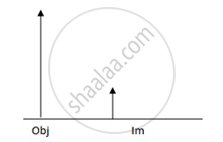
In the following diagram , the object and the image formed by the respective lenses are shown. Complete the ray diagram, and locate the focus. Find the focal length of the lens.
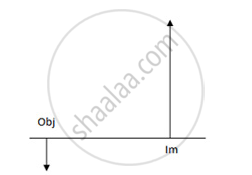
A lens forms the image of an object placed at a distance of 45 cm from it on a screen placed at a distance 90 cm on the other side of it. Name the kind of lens.
How will you differentiate between a convex and a concave lens by looking at a printed page?
Complete the following diagram and state what happens to the ray of light after refraction through the lens.
Draw a ray diagram to show the image formed by a convex lens when the object is placed between F and 2F.
