Advertisements
Advertisements
प्रश्न
A lens forms the image of an object placed at a distance of 45 cm from it on a screen placed at a distance 90 cm on the other side of it. Name the kind of lens.
Advertisements
उत्तर
As the image is formed on the other side of the lens, the image is real. Hence, the lens is a convex lens.

APPEARS IN
संबंधित प्रश्न
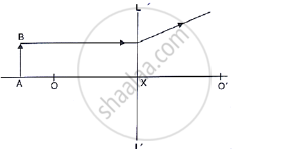
Study the diagram shown in Fig. 5.56
Complete the diagram to show the formation of image A’B’ of the object AB of same size.
For an object placed at a distance 20 cm in front of a convex lens, the image is at a distance 20 cm behind the lens. The focal length of the convex lens is ______.
State the condition of the following:
A ray passes undeviated through the lens.
(a) Draw a sketch to show how a lens is able to produce an image of the sun on a paper screen.
(b)(i) Would you regard the rays from the sun as being divergent, parallel or convergent?
(ii) What is the name given to the point where such rays meet after they have passed through the lens?
(iii) How does the image of the sun sometimes burn a paper screen?
Make the rrect choices in the following items :
An object is placed 50 cm from a connverging lens of focal length 30 cm. The image produced would be
Define the term focus of a lens.
State the nature and position of the object on the principal axis to obtain a real and magnified image.
When does a ray of light falling on a lens pass through it undeviated?
In the following diagram, L1 and L2 are the two convex lense placed at separation equal to the sum of focal lengths of the two lenses. A and B are the two rays of light incident on the lens L1. Complete the path of rays till they emerge out of the lens L2.
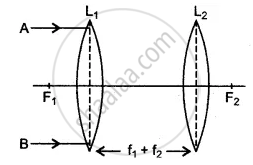
What principles have you used in completing the diagram?
Mixture of red + blue + green is passed through a convex lens as shown in the diagram below. State whether the ray passes through a single point or through different points on the principal axis after refraction.

