Advertisements
Advertisements
प्रश्न
State the nature and position of the object on the principal axis to obtain a real and magnified image.
Advertisements
उत्तर
Lens is convex; the position of the object is between F and 2F.
संबंधित प्रश्न
Explain optical centre of a lens with the help of proper diagram(s).
In the following figure (a) and (b), F1 and F2 are positions of the two foci of thin lenses. Draw the path taken by the light ray AB after it emerges from each lens.
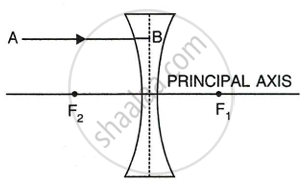 |
| (a) |
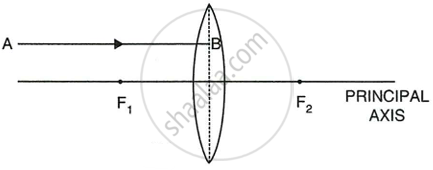 |
| (b) |
Study the diagram shown in Fig. 5.56
Complete the diagram to show the formation of image A’B’ of the object AB of same size.
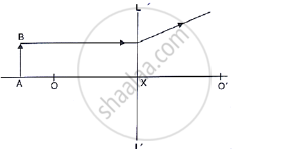
The diagram given below shows the position of an object OA in relation to a converging lens L whose foci are at F1 and F2.

- Draw two rays to locate the position of the image.
- State the position of the image with reference to the lens.
- Describe three characteristics of the image.
- Describe how the distance of the image from the lens and its size change as the object is moved towards F1.
The diagram given below shows the position of an object OA in relation to a converging lens whose foci are at F1 and F2.
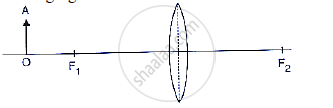
Describe how the distance of the image from the lens and the size of the image change as the object is moved towards F1.
In the following diagram the object and the image formed by the respective lenses are shown. Complete the ray diagram, and locate the focus. Find the focal length of the lens.
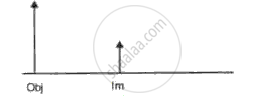
In the following diagram , the object and the image formed by the respective lenses are shown. Complete the ray diagram, and locate the focus. Find the focal length of the lens.
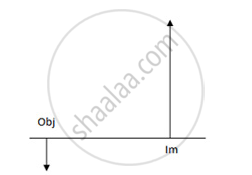
Make the rrect choices in the following items :
An object is placed 50 cm from a connverging lens of focal length 30 cm. The image produced would be
Define the term focus of a lens.
Name the subjective property of light related to its wavelength.
