Advertisements
Advertisements
प्रश्न
Compare the rates of emission of heat by a blackbody maintained at 727°C and at 227°C, if the black bodies are surrounded by an enclosure (black) at 27°C. What would be the ratio of their rates of loss of heat?
Advertisements
उत्तर
Data: T1 = 273 + 727 = 1000 K,
T2 = 273 + 227 = 500 K,
T0 = 273 + 27 = 300 K
(i) The rate of emission of heat, `"dQ"/"dt" = sigma"AT"^4`.
We assume that the surface area A is the same for the two bodies.
`∴ ("dQ"//"dt")_1/("dQ"//"dt")_2 = "T"_1^4/"T"_2^4 = ("T"_1/"T"_2)^4`
`= (1000/500)^4 = 2^4 = 16`
(ii) The rate of loss of heat, `"dQ'"/"dt" = sigma"A" ("T"^4 - "T"_0^4)`
`∴ ("dQ'"//"dt")_1/("dQ'"//"dt")_2 = ("T"_1^4 - "T"_0^4)/("T"_2^4 - "T"_0^4)`
`= (10^12 - 81 xx 10^8)/(625 xx 10^8 - 81 xx 10^8)`
`= ((10000 - 81) xx 10^8)/(544 xx 10^8)`
`= 9919/544 = 18.23`
APPEARS IN
संबंधित प्रश्न
Can we define the temperature of (a) vacuum, (b) a single molecule?
If the molecules were not allowed to collide among themselves, would you expect more evaporation or less evaporation?
The pressure of an ideal gas is written as \[P = \frac{2E}{3V}\] . Here E refers to
The average translational kinetic energy of air molecules is 0.040 eV (1 eV = 1.6 × 10⁻¹⁹J). Calculate the temperature of the air. Boltzmann constant k = 1.38 × 10⁻²³ J K−1.
0.040 g of He is kept in a closed container initially at 100.0°C. The container is now heated. Neglecting the expansion of the container, calculate the temperature at which the internal energy is increased by 12 J.
Use R = 8.3 J K-1 mol-1
During an experiment, an ideal gas is found to obey an additional law pV2 = constant. The gas is initially at a temperature T and volume V. Find the temperature when it expands to a volume 2V.
Use R = 8.3 J K-1 mol-1
An ideal gas is trapped between a mercury column and the closed-end of a narrow vertical tube of uniform base containing the column. The upper end of the tube is open to the atmosphere. The atmospheric pressure equals 76 cm of mercury. The lengths of the mercury column and the trapped air column are 20 cm and 43 cm respectively. What will be the length of the air column when the tube is tilted slowly in a vertical plane through an angle of 60°? Assume the temperature to remain constant.
One mole of an ideal gas undergoes a process `P = (P_0)/(1+(V/V_0)^2` where `p_0` and `V_0` are constants . Find the temperature of the gas when `V=V_0` .
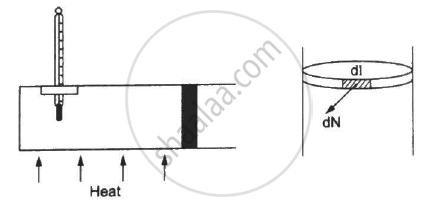
Figure shows a cylindrical tube of radius 5 cm and length 20 cm. It is closed by a tight-fitting cork. The friction coefficient between the cork and the tube is 0.20. The tube contains an ideal gas at a pressure of 1 atm and a temperature of 300 K. The tube is slowly heated and it is found that the cork pops out when the temperature reaches 600 K. Let dN denote the magnitude of the normal contact force exerted by a small length dlof the cork along the periphery (see the figure). Assuming that the temperature of the gas is uniform at any instant, calculate `(dN)/(dt)`.
Answer in brief:
A gas in a cylinder is at pressure P. If the masses of all the molecules are made one-third of their original value and their speeds are doubled, then find the resultant pressure.
Compare the rms speed of hydrogen molecules at 127°C with rms speed of oxygen molecules at 27ºC given that molecular masses of hydrogen and oxygen are 2 and 32 respectively.
Two vessels A and B are filled with the same gas where the volume, temperature, and pressure in vessel A is twice the volume, temperature, and pressure in vessel B. Calculate the ratio of the number of molecules of the gas in vessel A to that in vessel B.
Energy is emitted from a hole in an electric furnace at the rate of 20 W when the temperature of the furnace is 727°C. What is the area of the hole? (Take Stefan’s constant σ to be 5.7 × 10⁻⁸ Js-1 m-2K-4.)
The number of degrees of freedom, for the vibrational motion of a polyatomic molecule, depends on the ______
The power radiated by a perfect blackbody depends only on its ______
Calculate the value of λmax for radiation from a body having a surface temperature of 3000 K. (b = 2.897 x 10⁻³ m K)
Under which condition laws of Boyle, Charles, and Gay-Lussac are valid?
A ring of mass m and radius r rotates about an axis passing through its centre and perpendicular to its plane with angular velocity `omega`. Its kinetic energy is ______.
The average translational kinetic energy of a molecule in a gas becomes equal to 0.49 eV at a temperature about (Boltzmann constant = 1.38 x 10⁻²³ JK-1) ____________.
Assuming the expression for the pressure exerted by the gas on the wall of the container, it can be shown that pressure is ______.
The average translational kinetic energy of a molecule in a gas is 'E1'. The kinetic energy of the electron (e) accelerated from rest through p.d. 'V' volt is 'E2'. The temperature at which E1 = E2 is possible, is ______.
The molecules of a given mass of a gas have root mean square speeds of 100 ms−1 at 27°C and 1.00 atmospheric pressure. What will be the root mean square speeds of the molecules of the gas at 127°C and 2.0 atmospheric pressure?
A gas mixture consists of molecules of types A, B and C with masses mA > mB > mC. Rank the three types of molecules in decreasing order of average K.E.
A gas mixture consists of molecules of types A, B and C with masses mA > mB > mC. Rank the three types of molecules in decreasing order of rms speeds.
If a = 0. 72 and t = 0.04, then the value of r is ______.
At what temperature will therms velocity of a gas be four times its value at STP?
2000 calories of radiant heat is incident on a body. If the body absorbs 550 calories of heat, find the coefficient of emmission of the body.
