Advertisements
Advertisements
प्रश्न
Compare the rates of emission of heat by a blackbody maintained at 727°C and at 227°C, if the black bodies are surrounded by an enclosure (black) at 27°C. What would be the ratio of their rates of loss of heat?
Advertisements
उत्तर
Data: T1 = 273 + 727 = 1000 K,
T2 = 273 + 227 = 500 K,
T0 = 273 + 27 = 300 K
(i) The rate of emission of heat, `"dQ"/"dt" = sigma"AT"^4`.
We assume that the surface area A is the same for the two bodies.
`∴ ("dQ"//"dt")_1/("dQ"//"dt")_2 = "T"_1^4/"T"_2^4 = ("T"_1/"T"_2)^4`
`= (1000/500)^4 = 2^4 = 16`
(ii) The rate of loss of heat, `"dQ'"/"dt" = sigma"A" ("T"^4 - "T"_0^4)`
`∴ ("dQ'"//"dt")_1/("dQ'"//"dt")_2 = ("T"_1^4 - "T"_0^4)/("T"_2^4 - "T"_0^4)`
`= (10^12 - 81 xx 10^8)/(625 xx 10^8 - 81 xx 10^8)`
`= ((10000 - 81) xx 10^8)/(544 xx 10^8)`
`= 9919/544 = 18.23`
APPEARS IN
संबंधित प्रश्न
Do you expect the gas in a cooking gas cylinder to obey the ideal gas equation?
If the molecules were not allowed to collide among themselves, would you expect more evaporation or less evaporation?
Is it possible to boil water at room temperature, say 30°C? If we touch a flask containing water boiling at this temperature, will it be hot?
The mean square speed of the molecules of a gas at absolute temperature T is proportional to
Find the number of molecules of an ideal gas in a volume of 1.000 cm3 at STP.
0.040 g of He is kept in a closed container initially at 100.0°C. The container is now heated. Neglecting the expansion of the container, calculate the temperature at which the internal energy is increased by 12 J.
Use R = 8.3 J K-1 mol-1
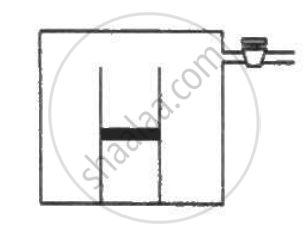
An ideal gas is kept in a long cylindrical vessel fitted with a frictionless piston of cross-sectional area 10 cm2 and weight 1 kg in figure. The vessel itself is kept in a big chamber containing air at atmospheric pressure 100 kPa. The length of the gas column is 20 cm. If the chamber is now completely evacuated by an exhaust pump, what will be the length of the gas column? Assume the temperature to remain constant throughout the process.
The weather report reads, "Temperature 20°C : Relative humidity 100%". What is the dew point?
The temperature and the dew point in an open room are 20°C and 10°C. If the room temperature drops to 15°C, what will be the new dew point?
A glass contains some water at room temperature 20°C. Refrigerated water is added to it slowly. when the temperature of the glass reaches 10°C, small droplets condense on the outer surface. Calculate the relative humidity in the room. The boiling point of water at a pressure of 17.5 mm of mercury is 20°C and at 8.9 mm of mercury it is 10°C.
An adiabatic cylindrical tube of cross-sectional area 1 cm2 is closed at one end and fitted with a piston at the other end. The tube contains 0.03 g of an ideal gas. At 1 atm pressure and at the temperature of the surrounding, the length of the gas column is 40 cm. The piston is suddenly pulled out to double the length of the column. The pressure of the gas falls to 0.355 atm. Find the speed of sound in the gas at atmospheric temperature.
If a = 0.72 and r = 0.24, then the value of tr is ______.
Answer in brief:
A gas in a cylinder is at pressure P. If the masses of all the molecules are made one-third of their original value and their speeds are doubled, then find the resultant pressure.
At what temperature will oxygen molecules have same rms speed as helium molecules at S.T.P.? (Molecular masses of oxygen and helium are 32 and 4 respectively).
Find the temperature of a blackbody if its spectrum has a peak at (a) λmax = 700 nm (visible), (b) λmax = 3 cm (microwave region) (c) λmax = 3 m (short radio waves). (Take Wien’s constant b = 2.897 × 10⁻³ m.K).
The power radiated by a perfect blackbody depends only on its ______
Why the temperature of all bodies remains constant at room temperature?
The average translational kinetic energy of a molecule in a gas becomes equal to 0.49 eV at a temperature about (Boltzmann constant = 1.38 x 10⁻²³ JK-1) ____________.
Average kinetic energy of H2 molecule at 300K is 'E'. At the same temperature, average kinetic energy of O2 molecule will be ______.
Assuming the expression for the pressure exerted by the gas on the wall of the container, it can be shown that pressure is ______.
The average translational kinetic energy of a molecule in a gas is 'E1'. The kinetic energy of the electron (e) accelerated from rest through p.d. 'V' volt is 'E2'. The temperature at which E1 = E2 is possible, is ______.
Two molecules of a gas have speeds of 9 × 10 6 ms−1 and 1 × 10⁶ ms−1, respectively. What is the root mean square speed of these molecules?
The Q-value of a nuclear reaction and kinetic energy of the projectile particle, KP are related as ______.
For a particle moving in vertical circle, the total energy at different positions along the path ______.
According to the kinetic theory of gases, at a given temperature, molecules of all gases have the same ______.
If a = 0. 72 and t = 0.04, then the value of r is ______.
If a = 0. 72 and r = 0.24, then the value of t is ______.
2000 calories of radiant heat is incident on a body. If the body absorbs 550 calories of heat, find the coefficient of emmission of the body.
