Advertisements
Advertisements
प्रश्न
Cochin is called the ______of the East.
विकल्प
Granary
Cuba
Venice
Pearl
Advertisements
उत्तर
Cochin is called the Venice of the East.
APPEARS IN
संबंधित प्रश्न
Read the poem aloud using proper rhythm and intonation.
Learn and recite the poem.
Do you think they had a memorable and enjoyable school trip?
Tiger hill has earned international fame for the best sunset view.
In 394 BCE, the ________ stopped the Greek Olympic Games, because they didn’t like them.
Listen to the paragraph and fill in the blanks.
The ______________South Indian floods resulted from heavy rainfall generated by the annual north east monsoon in _________________ 2015. They affected the ___________ region of the South Indian states of _________________, and the Union Territory of ___________, with Tamil Nadu and the city of __________________ particularly hard-hit. More than ________ people were killed and over 18 lakh people were______________. With estimates of damages and losses ranging from nearly 200 billion rupees to over 1 trillion rupees, the ___________ were the costliest to have occurred in 2015, and were among the costliest natural disasters of the year. The flooding has been attributed to the 2014-16 ________________ .
Listen to the passage about Nammazhwar, an environmental crusader from Tamil Nadu. As you listen, answer the following questions. The listening act can be repeated if required.
Who is Nammazhwar? What is his contribution to farmers and farming?
Complete the table with suitable responses.
| Sr.No. | CAUSE | ACTION | EFFECT |
| 1. | Krishna Deva Raya wants all the best things in the world. | He pays 1000 gold coins for the red peacock. | |
| 2. | Chatur Pandit is greedy and wants to get rich. | The king banishes him from the court for a month. | |
| 3. | He hires a painter and paints four peacocks red. | He proves that the king spends money needlessly. |
On the basis of the listening passage, choose the correct answer from the given options.
Severn Suzuki condemns the people of her country for ______.
The brothers are planning to celebrate their ___________ wedding anniversary.
State whether the statement is true or false.
The brothers have decided to borrow money for the wedding anniversary celebration.
Preethi Srinivasan is a former cricketer from Tamil Nadu.
______ into your irctc account.
The __________ and __________ of your journey must also be selected.
After filling information and captcha click on __________ booking.
Santhiya can’t live without her mobile phone.
What happened there?
Her mobile phone is also a kind of ______.
Madhubani paintings are from ______state.
Dilli Haat is a _______.
Announcement 3
What are things that should be turned off?
Choose the correct one after listening to the announcement.
The Kovai Superfast Express is arriving on platform no. ______.
Choose the correct one after listening the movie clip.
Bart wants to help his mom.
Choose the correct one after listening the movie clip.
The can is in the fridge.
Listen to the conversation and answer the following.
What type of coffee did the customer order?
- instant
- black
- filter
Listen to the following paragraph.
|
The Ant and the Dove On his way home, an ant saw a sparkling fountain. He crawled onto its wall to take a closer look.
Suddenly he slipped and fell into the water. He gurgled and panicked and waved his legs in the air. “Help! I can't swim,” he cried. Luckily, just at that moment, a friendly dove flew by. She saw that the tiny ant was drowning and quickly flew to a nearby tree. She pulled off a leaf and let it glide down to the ant. “Here you are,” she cooed and flew away.
(Adapted from Aesop’s Fables) |
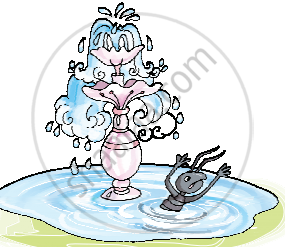

- Why do you think the dove helped the ant?
- How do you think the ant felt on finding the leaf?
- Have you ever been in trouble like the ant? Did anyone help you?
Listen to the audio and choose true or false.
It gives confidence and peace of mind.
Listen to the information about Vishalini and complete her profile with suitable words/phrases.
Vishalini, hailing from ______in Tamilnadu is ______years old. She is endowed with an outstanding ______and ______skills. Her IQ is ______, higher than the previous score of ______. She has been the ______speaker in International conferences. At the Google India Summit, she was honoured as the youngest ______. She is the recipient of ______international awards. This child prodigy is considered a ______girl.
______ was one of the places visited by Mahesh.
First, read the question given below, then listen to the poem, read aloud by the teacher, or played on an audio player. Then answer the question based on your listening of the poem.
Midnight Wonders
I was tossing in my bed in the midnight hour, struggling to get a wink of sleep, but my eyes lay on the clock tower.
I looked upon the dark sky; it was adorned with sparkling pearls, which giggled at me and put a shine to my curls.
I gazed at the chubby moon, which was white and glistening like milk. Gave me a lovely, motherly smile through her lips as rosy pink.
All these magnificent objects made my mind calm. My eyelids started drooping. I was grateful for their wonderful charm.
Nature had arrived to aid me when I was trying to catch sleep. She, with her caring palms, lulled me to slumber, so deep.
1. The poet was tossing in the bed awake because ______
- he was worried
- he was struggling to sleep
- it was daytime
- he was tired
2. The ______were ‘sparkling as pearls’.
- moon
- sun
- stars
- meteoroids
3. The ______gave the poet a motherly smile.
- sun
- stars
- moon
- sky
4. ______made the poet’s eyelids droop.
- nature
- rosy lips
- songs
- tiredness
5. ______is the title of the poem.
- Wonders
- Midnight Wonders
- Nature
- Midnight dreams
