Advertisements
Advertisements
प्रश्न
Classify the following function as injection, surjection or bijection : f : Z → Z given by f(x) = x3
Advertisements
उत्तर
f : Z → Z, given by f(x) = x3
Injection test:
Let x and y be any two elements in the domain (Z), such that f(x) = f(y)
f(x) = f(y)
x3 = y3
x = y
So, f is an injection.
Surjection test :
Let y be any element in the co-domain (Z), such that f(x) = y for some element x in Z(domain).
f(x) = y
x3 = y
x = 3sqrty which may not be in Z.
For example, if y = 3,
x =`3 sqrt3` is not in Z .
So, f is not a surjection and f is not a bijection .
APPEARS IN
संबंधित प्रश्न
Let A and B be sets. Show that f : A × B → B × A such that f(a, b) = (b, a) is bijective function.
Give examples of two functions f: N → Z and g: Z → Z such that g o f is injective but gis not injective.
(Hint: Consider f(x) = x and g(x) =|x|)
Classify the following function as injection, surjection or bijection :
f : R → R, defined by f(x) = |x|
Classify the following function as injection, surjection or bijection :
f : R → R, defined by f(x) = sin2x + cos2x
Classify the following function as injection, surjection or bijection :
f : Q − {3} → Q, defined by `f (x) = (2x +3)/(x-3)`
Show that the function f : R − {3} → R − {2} given by f(x) = `(x-2)/(x-3)` is a bijection.
If f : R → R be the function defined by f(x) = 4x3 + 7, show that f is a bijection.
If A = {1, 2, 3}, show that a one-one function f : A → A must be onto.
Find fog and gof if : f (x) = x2 g(x) = cos x .
Find fog and gof if : f(x)= x + 1, g (x) = 2x + 3 .
Consider f : R → R given by f(x) = 4x + 3. Show that f is invertible. Find the inverse of f.
If f : R → R be defined by f(x) = x3 −3, then prove that f−1 exists and find a formula for f−1. Hence, find f−1(24) and f−1 (5).
Which of the following graphs represents a one-one function?
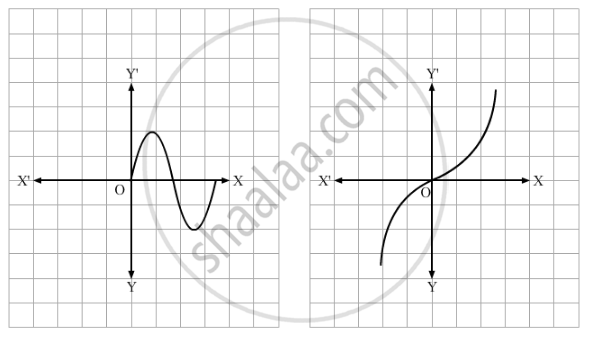
Let \[f : \left( - \frac{\pi}{2}, \frac{\pi}{2} \right) \to R\] be a function defined by f(x) = cos [x]. Write range (f).
Let f : R → R be defined as `f (x) = (2x - 3)/4.` write fo f-1 (1) .
Let A = {1, 2, 3, 4} and B = {a, b} be two sets. Write the total number of onto functions from A to B.
Let f, g : R → R be defined by f(x) = 2x + l and g(x) = x2−2 for all x
∈ R, respectively. Then, find gof. [NCERT EXEMPLAR]
A function f from the set of natural numbers to the set of integers defined by
\[f\left( n \right)\begin{cases}\frac{n - 1}{2}, & \text{when n is odd} \\ - \frac{n}{2}, & \text{when n is even}\end{cases}\]
If \[f\left( x \right) = \sin^2 x\] and the composite function \[g\left( f\left( x \right) \right) = \left| \sin x \right|\] then g(x) is equal to
Mark the correct alternative in the following question:
Let A = {1, 2, ... , n} and B = {a, b}. Then the number of subjections from A into B is
For sets A, B and C, let f: A → B, g: B → C be functions such that g o f is injective. Then both f and g are injective functions.
Let f: R → R be the function defined by f(x) = 2x – 3 ∀ x ∈ R. write f–1
Let f: `[2, oo)` → R be the function defined by f(x) = x2 – 4x + 5, then the range of f is ______.
Let A = R – {3}, B = R – {1}. Let f : A → B be defined by `"f"("x") = ("x" - 2)/("x" - 3)` Then, ____________.
Raji visited the Exhibition along with her family. The Exhibition had a huge swing, which attracted many children. Raji found that the swing traced the path of a Parabola as given by y = x2.
Answer the following questions using the above information.
- Let f: {1,2,3,....} → {1,4,9,....} be defined by f(x) = x2 is ____________.
Raji visited the Exhibition along with her family. The Exhibition had a huge swing, which attracted many children. Raji found that the swing traced the path of a Parabola as given by y = x2.
Answer the following questions using the above information.
- The function f: Z → Z defined by f(x) = x2 is ____________.
Let f: R → R defined by f(x) = 3x. Choose the correct answer
A function f: x → y is/are called onto (or surjective) if x under f.
'If 'f' is a linear function satisfying f[x + f(x)] = x + f(x), then f(5) can be equal to:
Number of integral values of x satisfying the inequality `(3/4)^(6x + 10 - x^2) < 27/64` is ______.
The domain of function is f(x) = `sqrt(-log_0.3(x - 1))/sqrt(x^2 + 2x + 8)` is ______.
For x ∈ R, x ≠ 0, let f0(x) = `1/(1 - x)` and fn+1 (x) = f0(fn(x)), n = 0, 1, 2, .... Then the value of `f_100(3) + f_1(2/3) + f_2(3/2)` is equal to ______.
Write the domain and range (principle value branch) of the following functions:
f(x) = tan–1 x.
Let A = R – {2} and B = R – {1}. If f: A `→` B is a function defined by f(x) = `(x - 1)/(x - 2)` then show that f is a one-one and an onto function.
A function is called many-one if two or more different elements of the domain have:
For \(f(x)=x^2+x\), if \(y=1\), which two domain elements have the same image?
